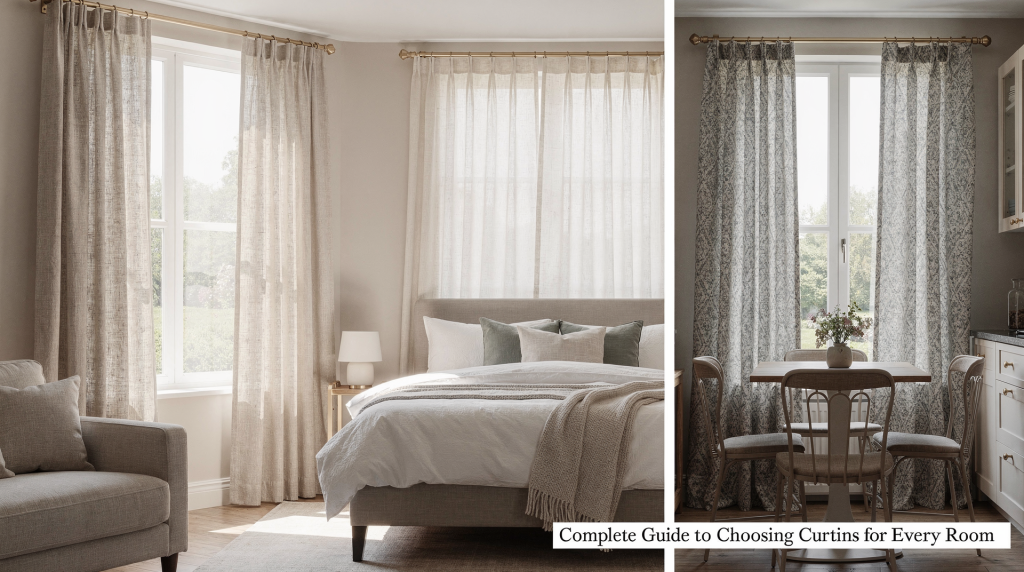
Curtains do far more than frame a window. They shape how a room feels the moment you walk in — how light falls across a sofa in the afternoon, how sound softens in a carpeted bedroom, how a drafty corner suddenly becomes the coziest spot in the house. The right pair depends on how the room is actually used, not just how it looks in a photograph. A curtain that works beautifully in a south-facing living room can feel completely wrong in a steamy kitchen or a street-level bedroom that needs real darkness for sleep. Getting it right means thinking about function first, and letting style follow naturally from there.
Why curtain choice matters
A bedroom curtain and a kitchen curtain should not be chosen the same way. One needs to block light and hold warmth through the night; the other needs to survive steam, cooking odors, and being pushed aside a dozen times a day. When the function is right, the room works better — you sleep more deeply, you feel less exposed to the street, you stop noticing the draft from the window. Style matters, but it’s the practical decisions that determine whether you’ll still be happy with your curtains a year later. A good curtain choice balances function first, then brings in color, texture, and pattern to support the room’s character.
Start with the room, not the fabric
Before you fall in love with a particular linen or a dramatic pattern, ask three practical questions that will guide every other decision:
- How much light does this room need — and at what times of day?
- How much privacy does it require — from the street, from neighbors, from the morning sun?
- How much wear and moisture will the curtains face — daily cooking, bathroom steam, children’s hands?
That simple check narrows the options quickly and saves you from the most common regret: buying curtains that look perfect on the rack but feel wrong after a week of real life. A north-facing living room may benefit from a warmer, heavier curtain that stops heat loss and makes the space feel cocooned rather than chilly. A sunny dining room might need a lined fabric to reduce fading on the front-facing side, especially if the table sits near the window. A bathroom curtain needs moisture resistance more than softness — no amount of beautiful drape compensates for mildew. Start with the room’s actual conditions, and the fabric choice becomes much clearer.
Curtain types and what they do best
| Curtain type | Best for | Main benefit | Watch out for |
|---|---|---|---|
| Sheer/voile | Living rooms, layered windows | Softens light while keeping a room airy | Limited privacy at night |
| Lined curtains | Most rooms | Better structure, light control, and fabric protection | Slightly heavier look |
| Blackout curtains | Bedrooms, nurseries, media rooms | Blocks more light for sleep and privacy | Can feel bulky if fabric is too heavy |
| Thermal curtains | Drafty rooms, older homes | Helps retain warmth and reduce heat loss | Not always the prettiest choice on its own |
| Unlined curtains | Decorative spaces, low-light rooms | Light, relaxed, natural feel | Less privacy and light control |
Lined curtains are often the safest all-round choice because they hang more neatly and usually last longer in sunny rooms — the lining takes the UV damage instead of the face fabric. Blackout and thermal linings are especially useful in bedrooms and cold spaces, but they change the weight and handle of the curtain noticeably. A blackout-lined curtain in a heavy velvet will feel substantial and luxurious; the same lining in a lightweight cotton can pull awkwardly and look stiff. Always consider how the lining and face fabric work together, not just what the label promises.
How to measure curtains correctly
The most common mistake I see in home tours — and it’s startlingly frequent — is measuring only the window itself. Curtains should be measured from the pole or track, not just the glass. This single error leads to panels that are too narrow, too short, or hung so low they shrink the entire room.
Width
For a full, tailored look, curtain fabric usually needs to be about 2 to 2.5 times the width of the window or track. That extra width creates soft, generous folds instead of a flat, skimpy panel that looks like an afterthought. When you draw the curtains closed, you want them to still have visible gathers — that’s the sign of proper fullness.
- Measure the full pole or track width, excluding decorative finials.
- Add enough fullness for the heading style — pencil pleats, eyelets, and pinch pleats all need different amounts.
- Check whether the curtain set width refers to one panel or the pair. A package labeled “140cm width” might mean each panel is 140cm, or it might mean the total pair. This catches people constantly.
Length
Measure from the point where the curtain will hang — the underside of the ring, the eyelet top, or the track — not from the top of the window frame itself. This is where the eye needs to be precise.
Common finishes:
- Sill length: ends just above the sill, practical for kitchens and bathrooms where fabric shouldn’t trail.
- Below-sill: drops below the sill for a softer effect, often used in dining rooms or bedrooms with radiators beneath the window.
- Floor length: stops just above the floor for a clean, intentional finish. This is the most versatile and polished look for living rooms and bedrooms.
For a polished look, floor-length curtains usually sit about 1–2 centimeters above the floor rather than puddling, unless you want a deliberately relaxed, romantic style. Puddled curtains collect dust and make vacuuming awkward; they’re a choice, not a default.
Best curtains for each room
Living room
The living room usually needs balance: daylight during the day, privacy at night, and a look that suits the room’s scale without dominating it. This is the room where curtains are most visible to guests and where you’ll spend hours in changing light conditions.
Best choices:
- Lined curtains for structure and light control — they hang with more weight and look intentional even when open.
- Sheers paired with heavier drapes for layering — this gives you three states: open, softly filtered, and fully closed.
- Natural fabrics such as linen blends for a relaxed, breathable look that ages well.
Practical tip: If the room has large windows, hang the pole higher and wider than the frame — extending 20–30 centimeters beyond each side and mounting it closer to the ceiling than the window top. This makes the window feel significantly bigger and lets more light in when the curtains are open. It’s one of the simplest tricks for making a room feel taller and more generous.
Bedroom
A bedroom curtain should support sleep first. Everything else — color, texture, pattern — is secondary to how dark and quiet the room feels when you’re trying to rest.
Best choices:
- Blackout curtains or blackout-lined curtains — these block external light from streetlamps, early sunrises, and car headlights.
- Thermal-lined curtains in colder homes — they add a layer of insulation that makes a noticeable difference on winter nights.
- Full-length curtains with enough fullness to block side light — light leaks around the edges are the enemy of good sleep, so the curtain should extend well beyond the window frame on both sides.
Common mistake: choosing a beautiful lightweight curtain that looks airy and romantic in the daytime but lets in so much light at night that the room never gets truly dark. If sleep quality matters — and it almost always does — prioritize lining over appearance alone. You can have both, but the lining comes first.
Kitchen
Kitchens need curtains that can handle steam, grease, and frequent opening without looking tired after a few months. This is not the place for delicate fabrics or elaborate headings.
Best choices:
- Short curtains, cafe curtains, or simple blinds with curtain panels — anything that stays clear of work surfaces and heat sources.
- Easy-care fabrics that can be taken down and washed without special treatment.
- Light-filtering styles that don’t absorb too much moisture — cotton and cotton blends work well here.
Avoid long, heavy curtains near hobs or sinks. They collect odors, absorb airborne grease, and get dirty faster than you’d believe. In a small kitchen, a cafe curtain mounted at the midpoint of the window gives privacy while leaving the upper glass clear for light — a solution that’s been working in European kitchens for generations.
Dining room
Dining rooms often work best with curtains that feel elegant but not fussy — the backdrop to meals and conversation rather than the main event.
Best choices:
- Lined curtains in textured fabric — the texture catches evening light beautifully and adds depth without pattern.
- Medium-weight materials that drape well and feel substantial when drawn.
- Subtle pattern or rich solid color — a deep ochre, a muted teal, a warm charcoal.
If the dining room doubles as a social space, think about how curtains look in evening light. Heavier fabrics can make the room feel more intimate and enclosed, which is often exactly what you want for dinner parties. The same curtains that feel too dark at noon can be perfect by candlelight.
Bathroom
Bathrooms need privacy and moisture resistance above all else. The fabric has to survive humidity spikes and occasional splashes without developing mildew or losing its shape.
Best choices:
- Short, washable curtains that can be cleaned regularly.
- Moisture-resistant fabrics where possible — polyester blends or treated cottons handle humidity better than pure natural fibers.
- Layered solutions with blinds for privacy — a moisture-safe blind paired with a decorative curtain panel outside the splash zone gives you both function and softness.
Curtains in bathrooms should stay away from constant splash zones — the area directly around the shower or bath. If the room is small, a lighter fabric keeps it from feeling boxed in; a heavy, dark curtain in a tiny bathroom can make the space feel claustrophobic.
Home office
A home office needs glare control more than darkness. The goal is to reduce screen reflections and harsh direct light without making the room feel dim or closed off during working hours.
Best choices:
- Light-filtering curtains that soften sunlight while keeping the room bright enough for video calls and focused work.
- Layered curtains with sheers — the sheer layer diffuses light during the day, and the heavier layer can be drawn for privacy in the evening.
- Medium-weight lined fabric if the room gets strong sun — this prevents the annoying situation where you have to choose between screen glare and working in the dark.
A well-chosen curtain can reduce screen glare without making the room feel dim or closed off. Position your desk so the window is to the side rather than directly behind or in front of you, and use curtains to control the light at its source.
Fabric guide: what each material feels like in a room
| Fabric | Look and feel | Best use |
|---|---|---|
| Linen | Relaxed, textured, breathable | Living rooms, bedrooms, soft modern interiors |
| Cotton | Clean, versatile, easy to style | Most rooms, especially casual spaces |
| Velvet | Rich, weighty, dramatic | Formal living rooms, bedrooms, larger spaces |
| Polyester blends | Practical, often budget-friendly | Busy households, rental homes, family rooms |
| Silk-style fabrics | Polished, elegant, delicate | Low-traffic decorative rooms |
If you want a curtain that hangs beautifully and is easy to live with, blends are often more practical than pure luxury fabrics. A linen-cotton blend gives you linen’s texture with cotton’s stability; a polyester-cotton blend resists wrinkles and washes easily. The right weave matters as much as the material itself — a tightly woven cotton can feel almost formal, while a loose-weave linen reads as effortlessly casual. Touch the fabric before you commit, and hold it up to the light to see how it filters.
Lining options explained simply
Lining changes how curtains function and how they hang. It’s not an upsell — it’s often the difference between curtains that look professional and curtains that look like they came in a flat pack.
- Standard lining adds body and protects the main fabric from fading. It gives the curtain more weight, which helps it hang in smooth, even folds.
- Blackout lining reduces light for better sleep. It’s thicker than standard lining and can affect how the curtain drapes — test it with your chosen face fabric to make sure it doesn’t pull or bunch oddly.
- Thermal lining helps with warmth and drafts. It’s particularly useful in older homes with single-glazed windows or in rooms that feel cold even with the heating on.
- Unlined curtains feel lighter and more casual, but offer less protection and structure. They work in rooms where light control isn’t critical and the relaxed look is intentional.
A lined curtain often looks fuller and more finished — the extra layer gives it substance. If a room faces direct sun, lining is not just a comfort choice; it helps extend the life of the fabric significantly. I’ve seen unlined linen curtains fade to a shadow of their original color within two summers on a south-facing window.
Color and pattern: how to choose without overthinking it
The safest curtain color is usually the one that supports the room’s main mood instead of competing with it. Curtains are large vertical surfaces — they have more visual weight than we tend to realize.
Use this simple rule:
- Choose a similar tone for calm and cohesion — curtains that are close to the wall color create a seamless, restful backdrop.
- Choose contrast for a stronger statement — dark curtains against light walls draw the eye and define the window as a feature.
- Use pattern when the room needs movement or character — a patterned curtain can energize an otherwise neutral space.
Practical examples:
- Small room: soft, light tones often feel less heavy and help the space feel more open. A pale linen or a warm ivory cotton can make a compact bedroom feel airier.
- Large room: deeper colors can add warmth and anchor the space — a charcoal, a deep blue, or a rich terracotta gives a big living room a sense of enclosure and comfort.
- Busy interior: solids or subtle texture usually work better than loud pattern. If the room already has patterned furniture, rugs, or wallpaper, let the curtains be the quiet element.
- Plain room: a patterned curtain can become the focal point — a botanical print, a geometric weave, or a stripe that echoes the room’s proportions.
Common mistakes to avoid
- Measuring the window instead of the pole or track — this leads to curtains that are too narrow and too short.
- Buying curtains that are too narrow and look flat — a curtain that’s exactly the width of the window has no fullness and looks like a bedsheet hung up as an afterthought.
- Using blackout curtains where you really need layered daylight control — in a living room, you often want to soften light during the day, not eliminate it entirely.
- Choosing delicate fabric in kitchens or bathrooms — silk-style curtains near a stove or shower will deteriorate fast.
- Ignoring the impact of lining on drape and fullness — a heavy lining can overwhelm a lightweight face fabric, making it hang stiffly.
- Hanging curtains too low, which makes the room feel smaller — the pole should be mounted high, close to the ceiling, to draw the eye upward.
A simple step-by-step checklist before you buy
- Identify the room’s main need: light control, privacy, insulation, or decoration.
- Measure the pole or track width accurately — not the window, not the recess, the actual pole.
- Decide on curtain length based on the look you want — sill, below-sill, or floor-length.
- Choose the fabric weight for the room’s conditions — heavy for cold rooms, light for humid rooms, washable for busy ones.
- Select lining based on light and temperature needs — standard, blackout, thermal, or none.
- Check fullness so the curtains won’t look skimpy — aim for 2 to 2.5 times the pole width.
- Match the curtain style to how often the room is used — high-traffic rooms need durable, easy-to-clean fabrics.
Quick room-by-room decision guide
| Room | Best starting point | Best lining | Best length |
|---|---|---|---|
| Living room | Lined linen or cotton-blend curtains | Standard lining | Floor length |
| Bedroom | Blackout or blackout-lined curtains | Blackout lining | Floor length |
| Kitchen | Short, easy-care curtains | Light lining or none | Sill or below-sill |
| Dining room | Textured lined curtains | Standard lining | Floor length |
| Bathroom | Short moisture-friendly option | As needed for privacy | Sill length |
| Home office | Light-filtering layered curtains | Standard lining | Floor length |
FAQ
How wide should curtains be for a normal window?
A good rule is to make the total curtain width about 2 to 2.5 times the pole or window width, depending on how full you want them to look. For a standard 150cm window, you’d want curtains with a combined width of 300–375cm. This gives you proper gathers when closed and a generous stack-back when open.
Should curtains touch the floor?
For most rooms, curtains look best when they stop just above the floor — about 1–2 centimeters of clearance. That gives a clean finish without dragging or collecting dust. The “puddling” look, where fabric pools on the floor, is a deliberate style choice that works in formal or romantic interiors but requires more maintenance and isn’t practical in high-traffic areas.
Are blackout curtains good for living rooms?
Yes, if the room gets strong sunlight or faces a busy street. They’re not only for bedrooms — a blackout-lined curtain can make a living room usable for watching films during the day or provide privacy from a directly opposite neighbor. However, they can make a living room feel heavier and darker during daylight hours, so consider lighter layering with sheers if daytime brightness matters to you.
Do I need lined curtains?
In most rooms, yes. Lining improves structure, helps reduce fading, and makes curtains hang better. The only exceptions might be decorative spaces where light control isn’t needed, or rooms where you specifically want an airy, unlined look — but even then, be aware that unlined curtains offer less privacy and will deteriorate faster in sunlight.
What is the best curtain choice for a rental?
A lined, neutral, floor-length curtain is usually the most flexible option. It works in many interiors and is easy to style around existing finishes — you’re not fighting the landlord’s beige walls or the existing carpet color. Choose a curtain with a universal heading style like eyelets or back tabs that fits standard poles, and you can take it with you when you move. Neutral doesn’t have to mean boring — a textured oatmeal linen or a soft greige cotton can look sophisticated and intentional.
Conclusion
The best curtain is the one that suits the room’s function as well as its style. Start with light, privacy, and practical conditions — how the room is used, what it faces, who spends time there — then choose fabric, lining, length, and fullness to match. When those basics are right, curtains stop looking like an afterthought and start making the whole room feel finished. They become part of how the space lives, not just how it looks in a photograph.