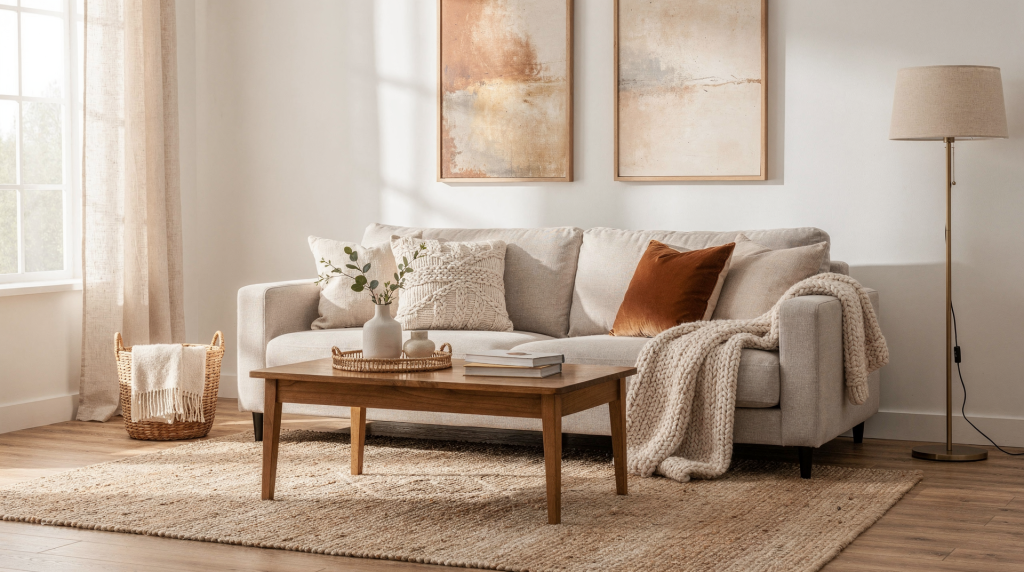
A living room that feels genuinely warm rarely owes that warmth to a single perfect sofa or an expensive rug. It’s the layering of materials — ones that invite touch, soften hard edges, and create visual depth — that makes a space feel lived-in, balanced, and comfortable through every season. The goal isn’t to fill the room with stuff; it’s to build a tactile landscape that works as well on a quiet Tuesday evening as it does when guests are over.
Why texture matters in a living room
Texture changes how a room feels even when the colour palette stays neutral. A mix of wool, linen, velvet, wood, rattan, leather, and ceramic keeps the eye moving and prevents the room from feeling flat. Designers often use contrast — soft against structured, matte against glossy, smooth against nubby — to make a room feel richer and warmer. Even in a room painted entirely in warm white, texture does the heavy lifting. A wool throw draped over a linen sofa, a rattan basket beside a smooth oak side table: these contrasts stop the space from reading as a showroom. Texture also shifts how a room sounds and feels underfoot, which is why it’s so critical in older homes with hard flooring or in rentals where you can’t change the walls.
Texture helps a living room do two jobs at once:
- look polished
- feel comfortable to use every day
If your room feels cold, sparse, or “finished” but not inviting, texture is usually what’s missing.
The basic rule: build layers from large to small
The easiest way to layer textures is to start with the biggest surfaces first, then work inward. Think of it as building a foundation: the largest areas set the stage, and the smaller details bring it to life. This approach prevents visual chaos and ensures every addition has a purpose.
1. Begin with the foundation
Your largest textural layer is usually the floor. If you have hardwood, tile, or laminate, an area rug is the fastest way to warm the room up. A rug anchors the seating area and gives the room a softer base underfoot. In a rental, a rug is your most powerful tool — it can transform a cold, echoing space in an afternoon.
Good foundation choices:
- wool rugs for softness and durability
- jute or sisal for a natural, more casual feel
- patterned rugs if the room needs more visual energy
- layered rugs if you want extra depth in a large room
2. Add the main seating texture
The sofa sets the tone for the entire room. A linen or woven upholstery feels relaxed; velvet reads richer; leather adds structure and contrast. If the sofa is smooth, bring in softer pillows and throws to break up the expanse. If the sofa is already plush, balance it with more structured accents nearby — a wooden side table or a metal floor lamp. The key is to avoid a monolithic block of one texture.
3. Work in medium layers
These are the elements people notice once they enter the room. They bridge the large surfaces and the small details:
- curtains
- accent chairs
- coffee table materials
- side tables
- baskets
- lampshades
A rattan lampshade, for instance, casts a dappled light that adds another layer of texture to the walls, while linen curtains soften the entire perimeter.
4. Finish with small tactile details
This is where the room starts to feel complete and personal:
- cushions in different weaves
- a chunky knit throw
- ceramic vases
- wood trays
- books with cloth or paper covers
- woven storage baskets
These details are what make a room feel collected rather than decorated. They invite touch and give the eye places to rest.
A simple formula that always works
The most reliably warm living rooms tend to include three to four clearly different textures within a controlled colour palette. Think of it as a quartet: soft, structured, natural, and reflective. The trick is not to use everything at once. A room with too many competing textures feels busy; a room with too few feels flat. The table below breaks down what each type contributes and where it works best.
| Texture type | What it adds | Best use |
|---|---|---|
| Soft | Comfort and warmth | Throws, cushions, upholstery |
| Structured | Balance and definition | Tables, shelving, frames |
| Natural | Ease and informality | Wood, rattan, jute, linen |
| Reflective | Light and contrast | Glass, metal, glazed ceramics |
Best textures for a warmer living room
Wool
Wool is one of the most effective ways to make a room feel warmer, partly because it holds heat and softens acoustics. In a rug, it adds both visual weight and a plush feel underfoot; as a throw, it invites you to sink in. Look for undyed or naturally flecked wools if you want the texture to read as organic rather than manufactured.
Use it for:
- area rugs
- blankets
- cushion covers
Linen
Linen softens a room without making it look overly heavy. It has a relaxed, breathable quality that works well in English homes, where natural light can change throughout the day. A stonewashed or mid-weight linen drapes beautifully and ages with grace — a curtain or sofa cover will develop a gentle patina over time.
Use it for:
- curtains
- sofa covers
- pillow covers
- lightweight throws
Velvet
Velvet creates instant richness, but it’s also a magnet for dust and pet hair in a busy household. Use it strategically: one velvet cushion on a linen sofa, or a small ottoman, can shift the mood without demanding high maintenance. Cotton velvet is more forgiving than silk blends and still catches the light beautifully.
Use it for:
- accent chairs
- occasional cushions
- ottomans
Wood
Wood adds warmth through grain, tone, and finish. Pale oak feels airy and Scandinavian; walnut reads deeper and more intimate. The key is to vary the finish — a rough-hewn side table next to a smooth oak floor creates subtle contrast. Even small wooden objects, like a turned bowl or a picture frame, can introduce that warmth.
Use it for:
- coffee tables
- side tables
- shelving
- frames
Rattan and wicker
These bring a lighter, natural texture that keeps the room from feeling too formal. They work especially well in spaces with a lot of upholstered pieces, breaking up the softness. A rattan lampshade casts a dappled light that adds another layer of texture to the walls.
Use it for:
- baskets
- occasional chairs
- lampshades
- storage pieces
Leather
Leather adds structure and contrast. It works especially well when the room has a lot of soft textiles already. Over time, leather develops a patina that only improves the room’s character. In a room full of linen and wool, a leather armchair or a simple leather tray on a coffee table provides an anchor.
Use it for:
- armchairs
- ottomans
- tray details
- accent accessories
How to layer textures without making the room cluttered
The biggest mistake is confusing “more texture” with “more stuff.” Texture should create depth, not noise. It’s about the variety of surfaces, not the number of objects.
Follow this order
- Start with one main soft element, usually the rug or sofa.
- Add one natural material, such as wood, linen, or rattan.
- Introduce one contrasting finish, such as velvet, leather, glass, or metal.
- Repeat one or two textures somewhere else in the room to create cohesion.
Repeat, don’t duplicate
If you use linen curtains, echo that feeling with a linen cushion or slipcover — not an identical piece, but something in the same material family. If you bring in a woven basket, repeat the natural tone in a wood frame or rattan lampshade. Repetition makes the room feel intentional without becoming matchy-matchy. It’s about rhythm, not uniformity.
Keep the palette controlled
Texture is easier to manage when the colour palette stays tight. Tonal neutrals, warm whites, muted browns, clay, olive, and soft charcoal all work well together. A strong palette with too many different textures can feel chaotic. If you’re drawn to bolder colours, limit the number of contrasting textures so the room doesn’t become visually exhausting.
Room-by-room texture ideas
Sofa zone
This is the easiest place to start because the sofa naturally invites layering. If your sofa is smooth leather, pile on a chunky knit throw and linen cushions; if it’s already a textured bouclé, keep the accents more restrained — maybe a single velvet cushion and a wooden side table.
Try:
- a textured sofa fabric
- two to four cushions in different weaves
- one throw with visible knit or fringe
- a side table in wood or stone
Avoid:
- cushions that all look identical
- too many shiny fabrics next to each other
- a sofa area with no contrast at all
Coffee table area
A coffee table can either calm the room or make it feel cluttered. The best approach is to mix one smooth element with one rough or natural one. Think of it as a still life that works from every angle.
Try:
- a wood tray on a glass or stone table
- ceramic objects next to books
- a woven basket underneath
- a stack of books with varied cover textures
Window area
Curtains are often overlooked, but they are one of the best ways to make a living room feel warmer. In a room with hard flooring and bare walls, linen curtains instantly soften the perimeter. For a more cocooning effect, layer heavier drapes over sheer blinds; the contrast in weight and opacity adds another dimension.
Try:
- linen curtains for softness
- heavier drapes for a more cocooning effect
- layered blinds and curtains if you want more depth
- curtain hardware that suits the rest of the room’s finish — a brushed brass rod against linen reads as intentional
Flooring
If the room still feels cold, the floor is usually the reason. In an English home, especially in older houses or rentals, hard flooring can make a room feel stark fast. A rug is non-negotiable here.
Try:
- a rug large enough to sit under the front legs of the sofa and chairs
- a smaller rug layered over a larger natural-fiber rug — the change in height underfoot is immediately comforting
- a rug with some pile if the room needs softness
Step-by-step: how to layer textures in one living room
Step 1: Identify what feels flat
Stand at the doorway and look at the room as a whole, not as a collection of furniture. Ask:
- Is the floor too hard?
- Is the sofa too smooth?
- Are the walls too bare?
- Does everything feel the same tone and finish?
These are the clues that texture is missing.
Step 2: Choose one warming anchor
Pick the biggest texture change first. In most rooms, this is the rug — it covers the largest horizontal plane. In others, it may be curtains or a slipcovered sofa. Start with the move that will have the most impact, then build around it.
Step 3: Add contrast
If the room has soft upholstery, add wood or metal. If it has a lot of hard surfaces, add wool, linen, or boucle. Contrast is what creates depth. Without it, even expensive pieces can look flat and uninviting.
Step 4: Repeat materials
Use each major texture at least twice in the room. For example, if you add oak in the coffee table, repeat it in a picture frame or shelf. This repetition makes the room feel cohesive, not chaotic.
Step 5: Edit
Step back and remove anything that feels decorative but not necessary. A warm room is layered, not crowded. If a vase or a cushion isn’t adding texture or comfort, it’s probably just visual noise.
Common mistakes to avoid
- Using the same texture in every item, which makes the room feel flat — all smooth leather and glass, for instance, can feel cold and one-dimensional.
- Adding too many patterns before the textures are balanced. Pattern reads as visual texture, and if the underlying tactile layers aren’t there, it can feel chaotic.
- Choosing only soft materials and forgetting structure. A room needs some hard edges to feel grounded.
- Using a rug that is too small to anchor the seating area. It should extend beyond the coffee table and at least under the front legs of the main pieces.
- Mixing warm and cool finishes without a clear plan. A cool grey sofa next to warm oak can work, but only if you bridge them with a textile that contains both tones.
- Buying decor pieces that look textured but do not add real depth — a printed faux-wood tray doesn’t do the same job as a solid oak one.
Texture combinations that work well
Some pairings are almost foolproof. The table below offers starting points for common room scenarios, but the principle is always the same: contrast and repeat.
| If your room has… | Add this | Why it works |
|---|---|---|
| A smooth sofa | Knit throws, woven cushions | Adds softness and contrast |
| A hard floor | Wool or layered rugs | Warms the room instantly |
| Lots of white walls | Wood, linen, baskets | Prevents the room from feeling sterile |
| A dark sofa | Light curtains, pale ceramics | Balances visual weight |
| Minimal decor | Mixed natural materials | Adds depth without clutter |
A practical checklist before you finish styling
- The floor has at least one soft layer.
- The sofa has at least two different textures around it.
- There is one natural material in the room.
- There is one contrasting finish, such as velvet, leather, glass, or metal.
- Curtains or window treatments add softness.
- No single material overwhelms the room.
- The room still feels easy to live in.
When less texture is better
Not every living room needs heavy layering. If the room is very small, already busy, or short on light, too many textures can make it feel cramped. In a compact living room, every surface counts, so let each texture breathe. Focus on a few strong choices:
- one great rug
- one tactile throw
- one natural wood piece
- one or two well-chosen cushions
That is often enough to make the room feel warmer without overworking it.
Final thoughts
Layering textures isn’t about following a trend; it’s about understanding how materials interact in a real room. The most inviting living rooms are the ones where you want to reach out and touch something — a nubby wool throw, a smooth ceramic bowl, a rough linen cushion. That tactile quality comes from contrast, repetition, and restraint. Start with the floor, add softness at seating level, bring in natural materials, and finish with small details that make the room feel personal.
FAQ
How many textures should a living room have?
Three to four distinct textures is a reliable baseline for a balanced room. More than that can work in larger spaces, but the key is to ensure they’re distributed, not clustered.
What is the easiest texture to add first?
A rug is almost always the fastest and most effective starting point because it covers the largest area and immediately changes how the room feels underfoot.
Can a neutral living room still feel warm?
Yes. Warmth comes from materials and contrast, not just colour. A room layered in tonal linens, wools, and woods can feel far warmer than one painted in a “warm” shade but filled with smooth, reflective surfaces.
What textures make a room feel cozy?
Wool, linen, velvet, boucle, wood, and woven natural fibers are the most reliable choices. They all invite touch and soften the hard edges of a room.
How do I make a rental living room feel warmer?
Use removable layers: rugs, throws, cushions, curtains, baskets, and table decor in natural materials. These add texture without permanent changes, and they can move with you.