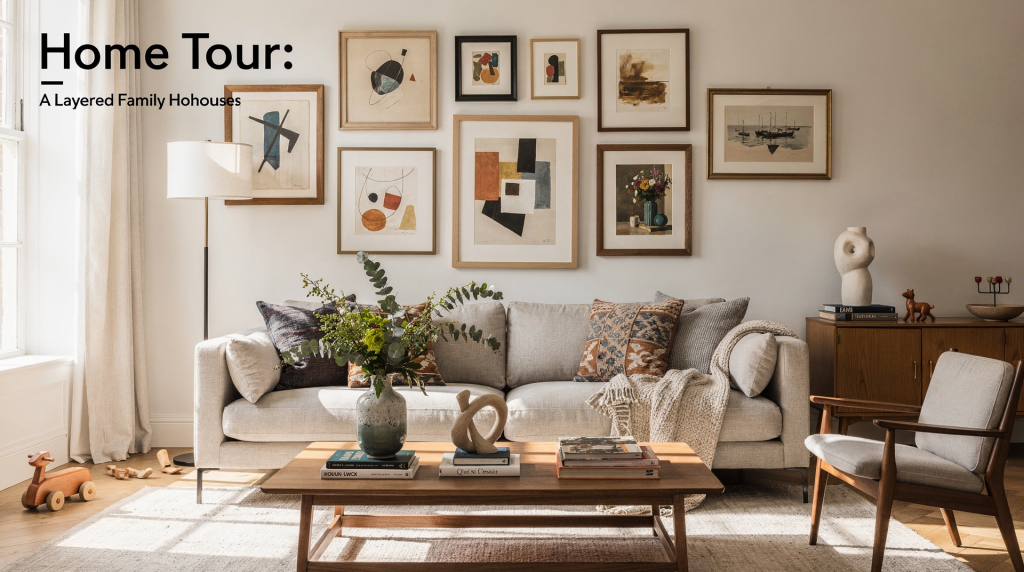
What makes a layered family house feel successful?
A layered home is not simply “full” of things. It has structure.
The best examples share a few qualities:
- A clear base palette that keeps the room calm
- Art placed with intention, not scattered at random
- Furniture that balances comfort with shape
- Textiles that soften hard edges and add depth
- Decorative objects chosen for meaning, scale, or texture
In a family house, this matters even more. Rooms need to work for daily life, so the design has to survive clutter, movement, and changing routines. The goal is not museum perfection. It is visual order that still feels welcoming.
The role of collected art in a family home
Collected art changes the mood of a house instantly. It gives rooms memory, personality, and rhythm. But it only works when the rest of the interior supports it.
What “collected” really means
Collected art does not have to be expensive or formal. It usually means a mix of pieces gathered over time:
- Family heirlooms
- Original works bought directly from artists
- Framed prints and photographs
- Pieces picked up while traveling
- Child-made art displayed thoughtfully
- Objects that behave like sculpture, even if they are not labeled as art
The key is variety with some visual logic. If every piece is equally loud, nothing stands out. If the collection has scale changes, different mediums, and a repeated sense of tone, the room feels intentional.
How to keep art from overwhelming the house
A common mistake is treating every wall like a gallery wall. In a family home, that often creates visual fatigue.
Use these rules instead:
- Leave some walls quiet so the art has impact
- Vary the height and size of pieces across rooms
- Give larger works room to breathe
- Mix framed pieces with shelves, ledges, and sculptural objects
- Let one strong work lead the room rather than competing with five smaller ones
The layering formula: base, texture, and accent
If the house feels collected rather than crowded, it usually follows a simple layering formula.
| Layer | Purpose | What it can include | Common mistake |
|---|---|---|---|
| Base | Creates calm and continuity | Walls, floors, large rugs, main upholstery | Using too many strong colors at once |
| Texture | Adds warmth and depth | Linen, wool, wood, stone, patina, woven pieces | Relying only on smooth or glossy finishes |
| Accent | Adds character and interest | Art, lamps, ceramics, vintage finds, books | Over-accessorizing every surface |
This structure keeps the home from feeling random. Even eclectic rooms need a framework.
How to style a layered room without making it look cluttered
The difference between layered and cluttered usually comes down to editing.
Start with the biggest shapes
Before thinking about accessories, look at the room’s main shapes:
- Sofa
- Dining table
- Storage pieces
- Rug
- Large artwork
- Lighting
These elements set the room’s visual weight. If they are balanced, the smaller objects can be more expressive.
Repeat materials to create cohesion
A collected room looks pulled together when materials repeat in different places.
For example:
- Warm wood in a coffee table, picture frame, and sideboard
- Linen in curtains, cushions, and upholstery
- Black metal in a lamp, shelf detail, and frame
- Ceramic in vases, tableware, and a sculptural object
This repetition creates quiet order, even when the pieces themselves come from different periods or styles.
Use negative space
Empty space is not wasted space. It helps the eye rest and makes the objects you do keep feel more important.
Good places to leave visual breathing room:
- Above a console
- On open shelving
- Around a large painting
- Between grouped objects
- On the floor around a key chair or stool
Room-by-room styling ideas
A layered family house does not need the same treatment in every room. Each space should support how it is actually used.
Living room
The living room is usually the most visible room, so it can carry the strongest art and the most texture.
Try this approach:
- Anchor the room with one large piece of art or a pair of related works
- Use a generous rug to define the seating area
- Add cushions in varied but related fabrics
- Include at least one vintage or unusual object to break up the expected
- Keep the coffee table styled lightly, not packed
Dining room
Dining rooms are ideal for more dramatic art because the furniture is visually simpler.
What works well:
- Oversized artwork or a small group hung as a single composition
- A pendant that creates atmosphere without stealing the show
- Upholstered chairs to soften the room
- A bowl, tray, or vessel rather than many small ornaments
Hallways and landings
These are often the best places for smaller art, because they are transition spaces.
Use them for:
- A narrow gallery arrangement
- Framed family pieces
- Travel photographs
- A single bench with a textile throw
- A shelf for rotating objects
Bedrooms
Bedrooms benefit from a quieter version of the same layered approach.
Keep it simple:
- Softer colors
- Fewer but more meaningful artworks
- Calming textiles
- One or two decorative objects only
- Lighting that feels warm, not harsh
Practical art placement tips
Art placement is where many rooms go wrong. The work may be good, but the hanging strategy makes it feel disconnected.
Do this
- Hang art at a height that relates to the furniture, not the ceiling
- Keep spacing consistent in a grouped arrangement
- Pair large furniture with art that has enough presence
- Consider leaning pieces on shelves or mantels for a more relaxed feel
- Use framing that suits the room, not just the artwork
Avoid this
- Hanging everything too high
- Using tiny art on very large walls without grouping
- Matching frames too aggressively
- Filling every surface with objects
- Hanging art before deciding where the furniture sits
Textiles: the fastest way to add depth
In a layered home, textiles do a lot of the heavy lifting. They soften hard materials and make the house feel lived in.
Useful textile layers include:
- Wool or jute rugs for grounding
- Linen curtains for softness and movement
- Cushions in different weaves and weights
- Throws draped casually, not perfectly folded
- Upholstery that can handle daily use
A family house needs textiles that are not just beautiful but forgiving. Washability, durability, and easy maintenance matter more than a perfect showroom finish.
Common mistakes in collected interiors
Even beautiful pieces can lose their effect if the room is not edited well.
| Mistake | Why it fails | Better approach |
|---|---|---|
| Too many focal points | The eye has nowhere to settle | Choose one main moment per room |
| Matching everything | The room feels flat and overdesigned | Mix periods, finishes, and textures |
| Art too small for the wall | The room looks unfinished | Scale up or group pieces |
| Over-styling shelves | The room feels staged, not lived in | Leave gaps and rotate objects |
| Ignoring function | The home looks good but does not work | Let daily use shape the layout |
A simple checklist for creating the look at home
Use this as a practical starting point.
Layered home checklist
- Choose a calm base palette
- Limit major finishes to a few recurring materials
- Select art with varied scale and medium
- Repeat one or two tones across the house
- Mix new pieces with vintage or inherited items
- Use textiles to soften hard surfaces
- Leave some walls and surfaces intentionally quiet
- Prioritize comfort and circulation first
- Edit again after the room is “done”
How to know when a room is finished
A room is usually finished when nothing feels rushed.
Ask these questions:
- Does one area draw the eye first?
- Is there enough contrast between soft and hard materials?
- Can the room handle real family life?
- Do the objects look chosen rather than accumulated?
- Is there one thing that feels slightly unexpected?
If the answer is yes to most of these, the room probably has the right level of layering.
Why this style works so well in family homes
Collected interiors suit family houses because they evolve naturally. They allow for gifts, travel finds, inherited pieces, and artworks gathered over time. That makes the home feel personal without needing constant reinvention.
The best family houses are not decorated all at once. They are built in layers, with each addition responding to the last. That is what gives them depth.
FAQ
What is a layered interior?
A layered interior combines texture, art, furniture, and objects in a way that feels cohesive but not overly matched.
How do you display art in a family home?
Use a mix of large statement pieces, grouped smaller works, and open space so the collection feels intentional rather than crowded.
Can a collected look still feel minimal?
Yes. The key is editing. A few well-chosen pieces with strong materials and enough negative space can feel collected without feeling busy.
What textiles work best in layered interiors?
Linen, wool, cotton, and woven natural fibers work especially well because they add softness and depth without feeling heavy.
How do I stop my house from looking cluttered?
Limit the number of focal points, repeat materials, and leave some surfaces empty. Layering only works when there is room to breathe.
Final thoughts
A layered family house with collected art is really about balance: personality without noise, comfort without dullness, and individuality without excess. When art, textiles, and furniture are edited with care, the house feels lived in for the right reasons — because it holds the people inside it well.