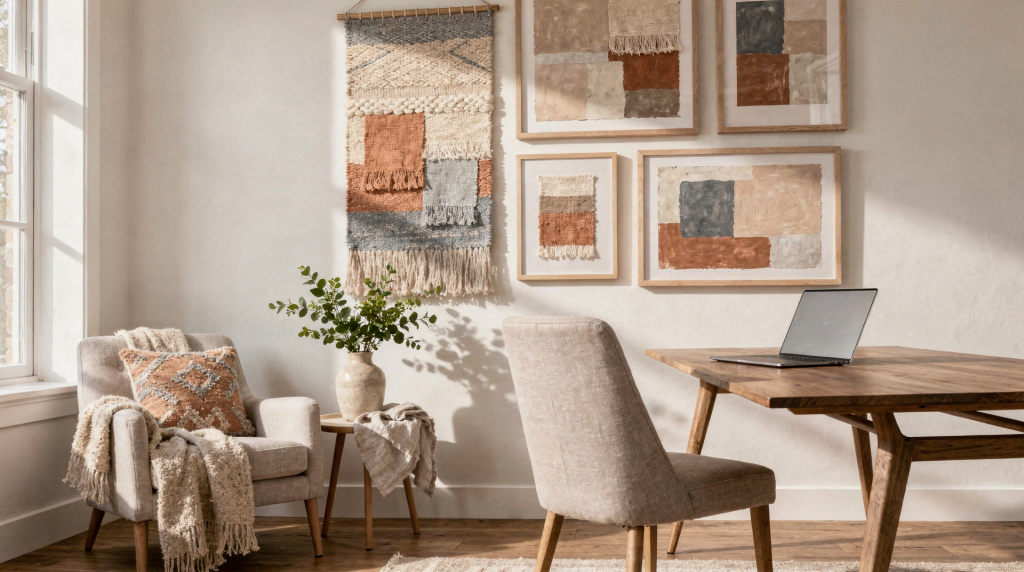
A home office should work hard, but it should also feel like part of your home. The fastest way to soften a desk setup, improve the backdrop on video calls, and make the room feel intentional is to combine art and textiles with a clear plan rather than adding decor at random. I’ve walked into too many spare-room offices where a single motivational print floats above a desk like an afterthought, and the only textile in sight is the chair mat. That’s not styling—that’s just filling wall space. The difference between a room that feels pulled together and one that feels like a temporary workstation almost always comes down to how art and fabric talk to each other.
Why art and textiles matter in a home office
Bare office corners tend to feel cold because they are dominated by screens, cables, and hard surfaces. Art brings personality and visual focus; textiles add softness, warmth, and a sense of calm. Used together, they can turn a functional workspace into a room you actually want to spend time in.
What I’ve noticed after years of watching how pieces behave in real rooms is that art does the heavy lifting for first impressions—it’s what people see on a video call or from the doorway—while textiles do the quieter work of making the room feel inhabited. A wool rug underfoot changes how sound moves through the space. Linen curtains take the edge off afternoon glare. A textured cushion on a desk chair makes the whole setup feel less like a corporate cubicle and more like a corner of someone’s actual home.
A good home office styling plan does three things:
- makes the desk area feel finished
- reduces the “temporary setup” look common in spare rooms
- supports focus without visual clutter
The third point matters more than people expect. A room that’s visually chaotic quietly drains concentration. The goal isn’t to strip everything back to nothing—it’s to choose pieces that feel deliberate enough that your eye can rest on them without getting distracted.
Start with the function of the room
Before choosing a print or throw, look at how the room is used. I’ve seen beautiful styling fall apart because someone picked art for a creative studio when they actually needed a backdrop for client calls five days a week. Function shapes everything: the palette, the scale of the pieces, how much visual energy the room can hold.
Ask these questions
- Is this a full-time workspace or a part-time desk nook?
- Is the desk seen on camera often?
- Do you need the room to feel calm, creative, formal, or relaxed?
- Is the space small and tight, or open enough for layered styling?
- Are you renting, or can you make holes in the wall?
The answer shapes every decision. A client-facing office usually needs quieter art and tighter composition—nothing that reads as chaotic or overly personal on screen. A creative studio can handle more color, texture, and visual movement because the room itself is part of the work. And a rental changes the whole hanging strategy: you might be leaning art on a shelf instead of anchoring it to the wall, which means thinking about weight, stability, and how the piece reads from a lower vantage point.
Choose an art direction that fits the work you do
Not every style of art belongs in every office. The safest choice is not the most boring one; it is the one that supports the room’s purpose. I’ve watched people gravitate toward bold, high-contrast pieces because they loved them in a gallery context, only to find that the same artwork felt aggressive when they sat across from it for eight hours a day. Context changes everything.
Best art styles for a home office
| Art style | Best for | Why it works |
|---|---|---|
| Abstract prints | Modern, creative, or minimalist offices | Adds color and interest without being distracting |
| Line art | Small spaces, calm interiors | Reads lightly and keeps the wall clean |
| Landscapes | Quiet, restorative workspaces | Creates a sense of depth and breathing room |
| Architectural photography | Professional or polished setups | Feels structured and timeless |
| Botanical prints | Softer, home-like offices | Brings an organic feel into tech-heavy spaces |
| Typography | Task-focused desks | Useful only if the message is short and genuinely motivating |
A simple rule: if you want the office to feel calmer, choose fewer colors and cleaner shapes. If you want more energy, use contrast, stronger color, or a more graphic image. But be honest about what you actually need from the room. A workspace that’s meant to help you focus shouldn’t feel like a gallery opening.
Where to place art in a home office
Placement matters as much as the artwork itself. In a home office, the most useful wall is usually the one behind the desk, because it is visible in your direct line of sight and on video calls. That wall sets the tone for the entire room, and it’s the one your colleagues or clients see most often.
Placement options that work
- Above the desk: best for a single large print or a neat pair of smaller works
- Beside the desk: good when the wall above the desk is interrupted by shelves, windows, or monitors
- On a nearby shelf: useful in rentals or compact rooms
- In a gallery arrangement on a side wall: works well when the desk wall needs to stay quiet
I’ve worked with spaces where the desk faced a window, and the only available wall was to the side. In those cases, a well-placed piece beside the desk can still anchor the room—it just needs to be large enough to hold its own without competing with the natural light.
Good hanging height
- Center large artwork roughly at eye level
- Keep the bottom edge high enough to avoid visual crowding over the desk
- Leave breathing room between the top of the desk and the bottom of the frame
If the art feels too close, the whole setup will feel compressed. If it hangs too high, the desk area can feel disconnected. A good test: sit in your desk chair and look straight ahead. The center of the artwork should be in your natural line of sight, not somewhere you have to tilt your head to find.
How to choose the right size
Size is where many home offices go wrong. Small art above a large desk looks accidental. Oversized art in a tiny nook can feel heavy. The goal is balance—and balance is about proportion, not just dimensions.
Practical size guidance
- For a standard desk, one medium-to-large piece usually works best
- For a narrow nook, use two smaller prints instead of one oversized piece
- For a wide wall, try a large single work or a disciplined two- or three-piece arrangement
- For a shelf-backed desk, lean artwork if you want a casual look, but make sure it still feels intentional
Leaning art works beautifully in the right context, but it needs weight and presence. A small framed print leaning on a shelf behind a monitor will read as clutter. A larger piece with a substantial frame can hold the space and feel like a deliberate choice.
A useful sizing test
Stand back and look at the desk wall from the doorway. If the art disappears, it is too small. If it competes with the desk and chair, it is too large. The artwork should feel like it belongs to the wall, not like it’s floating in the middle of it or overwhelming everything around it.
Textiles make the office feel livable
Textiles are the part of the room that most people forget, even though they often make the biggest difference. In a home office, textiles do three jobs: they soften hard surfaces, help absorb sound, and make the room feel less like a workstation. A room with a desk, a chair, and nothing else sounds hollow. Add a rug and a curtain, and suddenly the acoustics shift—conversations feel more contained, the clatter of a keyboard doesn’t echo, and the whole space settles into something more comfortable.
Textiles worth adding
- Rug
- Curtains or Roman shade
- Cushion on a desk chair
- Throw blanket on a reading chair
- Fabric pinboard
- Textile wall hanging
- Upholstered stool or bench
You do not need all of them. One or two well-chosen textiles can transform the space. I’ve walked into offices where a single wool rug changed the entire feel of the room—suddenly it was a place you wanted to sit in, not just work in.
The best textiles for different office types
| Textile | Best use | Design effect |
|---|---|---|
| Wool rug | Large offices, rooms with echo | Adds warmth and sound absorption |
| Flatweave rug | Small spaces | Gives structure without bulk |
| Linen curtains | Light-filled offices | Softens the room and controls glare |
| Velvet cushion | Formal or evening use | Adds depth and a richer tone |
| Woven wall hanging | Blank walls | Brings texture without more visual noise |
| Fabric pinboard | Planning-heavy desks | Functional and decorative at once |
| Throw blanket | Reading corners or lounge-style offices | Makes the room feel relaxed and finished |
If the office already has strong visual elements, keep textiles subtle. If the room is plain, textiles can carry more of the mood. A flatweave rug in a small office, for example, defines the floor area without adding visual weight. Linen curtains in a light-filled room do double duty: they filter harsh sunlight and introduce a soft, organic texture that balances out all the hard surfaces.
Layer art and textiles instead of treating them separately
The strongest home office styling looks considered because the materials support one another. A linen curtain, for example, pairs well with a soft abstract print. A wool rug works beautifully with architectural photography because both feel grounded and structured. When the materials have a conversation, the room feels cohesive rather than decorated.
Easy pairing formulas
- Abstract art + linen curtains
- Botanical print + woven rug
- Black-and-white photography + textured chair cushion
- Line art + neutral throw
- Colorful print + plain wool rug
When the art is bold, let the textiles calm it down. When the textiles are richly textured, let the art stay simpler. The idea is to create a balance where neither element is fighting for attention. I’ve seen rooms where a vibrant abstract print worked beautifully because every textile in the space was quiet and neutral—the art got to be the voice, and the fabrics provided the backdrop.
A step-by-step styling process
1. Clear the wall behind the desk
Remove everything that does not support the final composition. Start with one focal wall rather than decorating every wall in the room. This is the hardest step for most people because it means living with a blank wall for a moment, but it’s the only way to see the space clearly.
2. Pick one main visual story
Choose a direction such as calm, creative, refined, or cozy. This prevents the office from becoming a mix of unrelated ideas. Write down two or three words that describe how you want the room to feel, and use them as a filter for every decision that follows.
3. Add the largest piece first
Hang the main artwork before adding anything else. This sets the scale for the rest of the room. Once the art is in place, everything else—the rug, the cushion, the curtain—has something to respond to.
4. Bring in one textile anchor
Add the rug, curtain, or chair textile that grounds the space. Do not introduce too many patterns at once. Let the anchor piece settle into the room before you decide what else it needs.
5. Repeat one or two colors
Repeat colors from the artwork in the textiles, accessories, or chair upholstery. Repetition is what makes a room feel designed. Even a small echo—a cushion that picks up a tone from the print—can tie the whole composition together.
6. Edit aggressively
If the room starts to feel busy, remove one item. Offices need negative space more than living rooms do. A workspace that’s too full feels oppressive; one with room to breathe feels focused.
Common mistakes to avoid
1. Using art that is too small
Tiny prints above a desk make the room feel unfinished. If in doubt, go one size larger. A piece that’s slightly too big will almost always look more intentional than one that’s slightly too small.
2. Mixing too many patterns
A patterned rug, patterned curtains, patterned cushion, and busy print often compete instead of coordinating. Limit yourself to one or two patterns and let the rest of the room stay quiet.
3. Ignoring screen glare
Glossy frames and reflective glass can catch light badly near a monitor or window. If you’re working with a bright room, consider matte finishes or frames with less reflective surfaces.
4. Choosing decor that looks good but feels wrong to work with
A fluffy rug may look beautiful in photos but may not be practical under a rolling chair. Think about how you actually move through the space, not just how it photographs.
5. Hanging everything at random heights
Unrelated heights create visual tension. Keep frames and textiles aligned with the architecture whenever possible. A consistent line—whether it’s the top edge of the frames or the center point—gives the room a sense of order.
Styling ideas by office type
For a small home office nook
- Use one framed print or a pair of slim prints
- Add a textured cushion or small rug
- Keep the palette tight and calm
- Avoid heavy drapery and oversized wall pieces
In a compact nook, every piece needs to earn its place. A slim print above the desk and a textured cushion on the chair can be enough to make the corner feel finished without crowding it.
For a creative studio
- Choose a more expressive print or a small gallery wall
- Add layered textiles such as a patterned rug and fabric pinboard
- Use color, but repeat it deliberately
A creative space can handle more visual energy, but it still needs structure. A gallery wall works beautifully here, as long as the frames share a common thread—matching finishes, a consistent spacing, or a unifying color that runs through the collection.
For a professional client-facing office
- Go for a restrained palette
- Use architectural photography, abstract art, or muted landscapes
- Add natural texture through linen, wool, or subtle weave
This is the office where the backdrop matters most. The art should feel polished but not distracting, and the textiles should add warmth without calling attention to themselves. A well-framed architectural print above the desk and a wool rug underfoot strike the right balance.
For a rental
- Use command-style hanging solutions where allowed
- Lean artwork on shelves or the floor
- Bring in textiles through rugs, curtains, and cushions rather than permanent changes
Rentals demand flexibility, but they don’t have to feel temporary. Leaning a substantial piece of art on a shelf or console behind the desk creates the same anchoring effect as a hung piece, and a good rug can define the workspace even when you can’t change the walls.
A simple checklist before you finish
- Does the art feel large enough for the wall?
- Does the textile palette match the mood of the room?
- Is there enough empty space around the desk?
- Do the materials reduce glare and visual clutter?
- Would the room still look good on a video call?
- Does the office feel like part of the home, not just a work zone?
Run through this list before you consider the room done. The last question is the one that matters most: if the office feels like a separate, cordoned-off work zone, it hasn’t quite landed yet. The best home offices feel like they belong to the rest of the house.
Quick room formulas that always work
Calm and minimal
- One oversized neutral print
- Linen curtains
- Flatweave rug
- No more than two accent colors
This formula works because it gives the eye one clear focal point and keeps everything else quiet. The linen curtains soften the light, the flatweave rug defines the floor without adding bulk, and the neutral print anchors the wall without demanding attention.
Warm and creative
- Abstract artwork with soft color
- Woven wall hanging or textured cushion
- Wool rug
- One natural material repeated twice
Repetition is the key here. If the rug is wool, echo that texture somewhere else—a woven wall hanging, a textured cushion—so the materials feel connected rather than random.
Polished and professional
- Framed photography or architectural print
- Tailored curtain or plain blind
- Clean-lined rug
- Limited accessories
This is the formula for an office that needs to read as competent and composed. The art is structured, the textiles are tailored, and nothing in the room competes for attention. It’s a backdrop that supports the work rather than distracting from it.
FAQ
What kind of art is best for a home office?
Abstract prints, landscapes, architectural photography, and line art are the most reliable choices because they add interest without overwhelming the workspace. The best piece is one you can live with for hours at a time—something that rewards a glance but doesn’t demand constant attention.
Should art go behind the desk?
Usually yes. The wall behind the desk is often the best place for art because it anchors the room and creates a better backdrop for calls. If that wall isn’t available—because of windows, shelving, or an awkward layout—a side wall or a nearby shelf can work, as long as the piece is large enough to hold its own.
How many textiles should a home office have?
Start with one or two: a rug, curtain, cushion, or wall hanging. Add more only if the room still feels cold or unfinished. Most offices need less than people think—one good rug and one well-chosen curtain can do more than a pile of cushions and throws.
Can textiles make a home office quieter?
Yes. Rugs, curtains, upholstered pieces, and fabric wall elements can soften sound and reduce the hard, echoing feeling many offices have. A wool rug under the desk area is one of the most effective changes you can make for both acoustics and comfort.
What is the easiest way to make a home office feel styled?
Use one strong piece of art and one good textile. That combination is usually enough to make the room feel intentional. Once those two elements are in place, live with the space for a week before adding anything else—you might find it doesn’t need more.
Final thoughts
A well-styled home office is not about filling every wall. It is about choosing a few pieces that make the room feel calm, functional, and personal. Art gives the office a point of view; textiles give it comfort and depth. When those two elements work together, the space stops feeling temporary and starts feeling like a room you actually belong in. And that shift—from a place where you work to a place where you want to be—is the whole point.