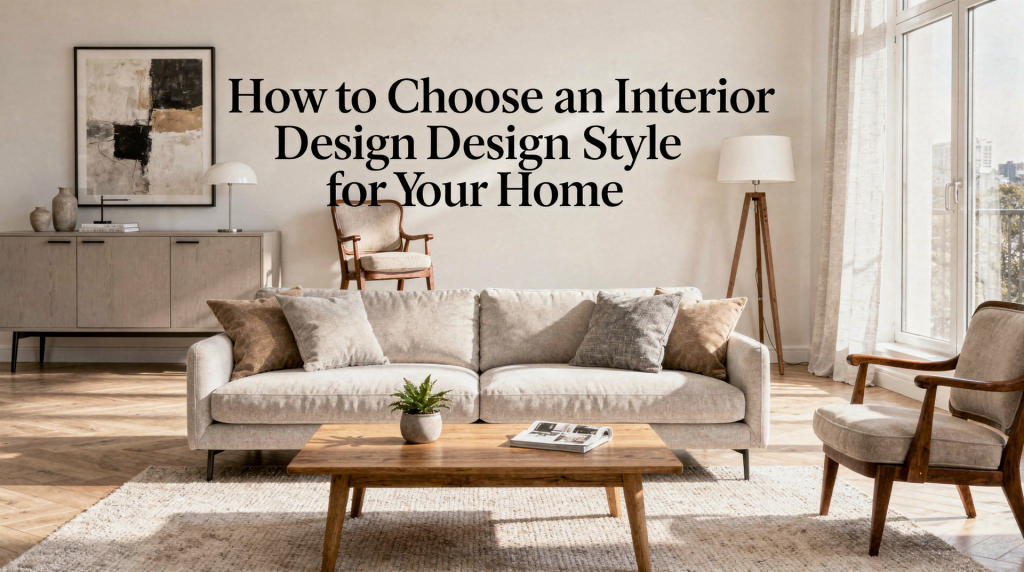
Choosing an interior design style is not about copying a picture-perfect room. It is about creating a home that fits how you live, what you already own, and the atmosphere you want to come home to every day. The best style feels intentional, practical, and easy to maintain — not forced.
Why your design style matters
An interior design style is the visual framework that shapes your decisions about furniture, color, materials, layout, and accessories. When that framework is clear, the room starts to feel coherent instead of random — every piece has a reason for being there, and the space reads as a whole rather than a collection of individual purchases.
A good style choice helps you:
- make faster decisions when buying furniture or decor
- avoid mismatched purchases that never quite work together
- build a room that supports your routine
- spend money on pieces you will actually keep
- create a home that feels like yours, not a showroom
The goal is not to fit into one rigid category. The goal is to understand what your home needs, then choose a style that supports it. I’ve seen too many rooms where the style was chosen first and the life had to squeeze in around it — that never holds up over time.
Start with how you live, not with aesthetics
The fastest way to get stuck is to begin with a mood board and ignore daily life. A home style should reflect how the space is used, who lives there, and how much maintenance you want to handle. I’ve walked into beautifully styled apartments that felt like museums — impressive for ten minutes, exhausting to actually inhabit.
Ask these questions first:
- Do you want a calm, quiet space or a more layered, expressive one?
- Do you host often, or is the home mostly for everyday living?
- Do you have children, pets, or frequent visitors?
- Do you need storage to be visible and accessible, or hidden away?
- How much time do you want to spend cleaning and styling?
This matters because a style is only successful if it works in real life. A highly decorative look may be beautiful, but if it creates clutter or constant upkeep, it will quickly stop feeling appealing. Think about how textiles behave in your daily routine — a pale linen sofa might look serene in photos, but if you have a dog who loves muddy walks, that choice will fight against your life every single day.
Understand the main interior design styles
Before you choose, it helps to know the broad families of style. The most common ones include Modern, Contemporary, Bohemian, Minimalist, Industrial, Traditional, and Transitional. Each one creates a different feeling, and understanding their core differences saves you from chasing labels that don’t actually match what you want.
| Style | Best for | Typical features |
|---|---|---|
| Modern | Clean, streamlined homes | Simple forms, neutral palette, minimal ornament |
| Contemporary | People who like current, evolving design | Soft lines, mixed materials, open feel |
| Minimalist | Clutter-free living | Limited decor, calm palette, functional furniture |
| Traditional | Homes that suit classic detail | Symmetry, richer finishes, formal arrangement |
| Transitional | A balanced middle ground | Mix of classic and modern elements |
| Industrial | Lofts, city apartments, bold character | Raw textures, metal, exposed elements |
| Bohemian | Creative, relaxed homes | Layered textiles, pattern, collected objects |
You do not need to memorize every style. You only need to notice which ones keep appearing in your inspiration and feel natural to you. Pay attention to the textures that draw you in — do you save images with rough linen, smooth leather, or soft wool? Those material preferences are often a more honest guide than any style name.
A practical method for choosing your style
If you are unsure where to begin, use this step-by-step process. I’ve used variations of this method with countless rooms, and it works because it starts with what’s already true about your space rather than imposing something from outside.
1. Audit what you already own
Look at your current furniture, rugs, art, lighting, and textiles. Identify what you want to keep. This step is more revealing than most people expect — your existing pieces already tell a story about what you’re drawn to.
Ask:
- What pieces do I genuinely like?
- Which items are too large, too small, or visually wrong for the room?
- What materials keep showing up — wood, metal, linen, leather, glass?
- Do my existing pieces lean warm, cool, formal, casual, rustic, or refined?
This is the foundation. Floors, doors, windows, and other fixed elements are expensive to change, so the smartest style choice works with them instead of against them. A home with warm oak floors and original crown molding will always feel more coherent with a style that acknowledges those features rather than pretending they don’t exist.
2. Define the feeling you want
Do not start with “I want Scandinavian” or “I want Japandi” unless you already know why. Start with the mood. Words are more flexible than labels, and they lead to better decisions.
Use simple words:
- airy
- cozy
- structured
- relaxed
- elegant
- understated
- lived-in
- dramatic
Then connect those words to visual cues. For example:
- airy often means light colors, open space, and slim furniture
- cozy often means layered textiles, softer lighting, and warmer tones
- structured often means symmetry, defined shapes, and fewer loose objects
- relaxed often means mixed materials, casual seating, and collected decor
This approach is more useful than chasing labels. I’ve worked with clients who thought they wanted Minimalism until we realized they actually wanted “calm” — which can also come from a well-edited Traditional room or a restrained Bohemian space.
3. Check your architecture and light
Your home already has a personality. The right style should complement it. Ignoring the bones of a room is like choosing an outfit without considering the weather — it might look good in theory, but it won’t work in practice.
Consider:
- ceiling height
- room size
- amount of natural light
- layout openness
- original features
- the age and character of the building
Small or dim rooms usually benefit from lighter colours and simpler furniture. Larger, brighter rooms can usually handle darker tones, heavier pieces, and more contrast. Light changes everything — a velvet sofa that looks rich and inviting in a sun-filled room can feel heavy and oppressive in a north-facing space with limited daylight.
A Victorian terrace, a new-build flat, and a countryside cottage will each feel different with the same furniture. That does not mean you must “match” the building perfectly. It means you should respect what is already there — work with the proportions, the light, and the existing materials rather than fighting them.
4. Choose one dominant style, then layer lightly
A common mistake is trying to combine too many aesthetics at once. The result is often visual noise — a room that feels busy rather than rich.
A better method is to choose:
- one dominant style
- one supporting influence
- a few repeating materials or colors
For example:
- Modern base + warm wood accents
- Traditional base + contemporary lighting
- Minimalist base + soft textile layering
- Industrial base + natural linen and plants
This is how rooms feel collected rather than confused. The supporting influence often shows up most effectively in the softer elements — a linen throw, a textured cushion, a piece of art that introduces an unexpected color. These are the layers that make a style feel personal without overwhelming the foundation.
How to compare styles in real life
When two or three styles appeal to you, compare them through practical filters instead of looks alone. A style that photographs beautifully might not hold up to your actual daily routine, so it’s worth asking the right questions before you commit.
| Question | Style leaning toward |
|---|---|
| Do I want things to look polished and symmetrical? | Traditional, Transitional |
| Do I want a cleaner, simpler room? | Modern, Minimalist |
| Do I like mixing textures, vintage finds, and art? | Bohemian, Eclectic |
| Do I want the home to feel current without looking trendy? | Contemporary, Transitional |
| Do I prefer raw materials and a more urban feel? | Industrial |
| Do I want softness and comfort above all? | Transitional, Bohemian |
This kind of comparison is especially useful when you are deciding between styles that look similar at first glance. Transitional and Contemporary, for instance, can appear nearly identical in photos, but Transitional leans more toward comfort and classic proportions, while Contemporary embraces current lines and a slightly more edited feel.
How to choose a style room by room
Not every room needs the exact same treatment. A cohesive home doesn’t mean every space looks identical — it means there’s a thread that connects them, whether that’s a consistent palette, a repeating material, or a shared approach to texture.
Living room
This is usually where your main style shows up most clearly. Prioritize comfort, seating layout, and a palette that feels easy to live with. The living room is where textiles do their heaviest lifting — a good rug anchors the seating area, cushions and throws soften the structure of sofas, and curtains control both light and acoustics.
Bedroom
Choose the most restful version of your style here. Even if the rest of the home is bold, the bedroom usually works best with softer contrast and fewer distractions. This is where bedding choices matter most — natural fibers like linen and cotton breathe better and feel more inviting than synthetics, and the texture of your bedding sets the tone for the entire room.
Kitchen
The kitchen often needs a more restrained approach because cabinets, counters, and appliances already create strong visual impact. Let the finishes guide the style. A few well-chosen textiles — a runner, a set of linen towels, a simple window treatment — can introduce warmth without competing with the hard surfaces.
Bathroom
Use texture, lighting, and simple color choices. Small bathrooms usually look better when the design is clear and uncluttered. Even here, textiles matter: a good bath mat, quality towels in a considered color, and a shower curtain in a natural material can elevate the space more than any decorative object.
Entryway
This space sets the tone. Even a small entry can express the style through a mirror, rug, lighting, or console table. The entryway is your home’s first impression — it should feel like a preview of what’s to come, not an afterthought.
Common mistakes when choosing a style
Choosing based on social media alone
A styled photo rarely shows storage needs, daily mess, or awkward room dimensions. What looks effortless on a screen often hides a reality of constant tidying, careful camera angles, and pieces chosen for the shot rather than for living.
Ignoring what you already own
If every piece of furniture must be replaced, the style may be too far from your current reality. The best rooms evolve — they don’t arrive fully formed in a single shopping trip. Working with what you have, even if it’s just a few pieces, grounds the space in your actual life.
Mixing too many references
If you are pulling from modern, rustic, boho, coastal, and vintage all at once, you need a stronger filter. A room with too many influences reads as indecisive. Choose your dominant thread and let the others show up as accents rather than equal players.
Picking a style that fights the architecture
Forcing a look that clashes with the room usually creates more work and less harmony. An ultra-modern interior in a Victorian terrace with ornate cornicing can feel like a battle between the room and its contents. The most satisfying spaces find common ground.
Following trends too closely
Trends are useful for accents, not as the entire foundation. Timeless base pieces make it easier to update the home later. I always recommend investing in the things that are hardest to change — sofas, dining tables, beds — and playing with trends through cushions, throws, art, and smaller accessories that can be swapped without regret.
A simple checklist before you commit
Use this before buying major pieces:
- I know the feeling I want the room to have
- I have identified the style that best supports that feeling
- The style fits the room’s size, light, and layout
- The style works with what I already own
- I can maintain the look realistically
- I have chosen a dominant style and a supporting accent style
- The palette, materials, and shapes repeat across the room
If most answers are “yes,” you are on the right track. This checklist has saved me from more impulsive purchases than I can count — there’s something about writing it down that makes vague doubts concrete.
Helpful examples of style direction
If you want a calm, modern home
Look at Modern or Minimalist foundations. Use clean lines, limited color, and a small number of quality pieces. In these spaces, texture does the work that pattern and ornament do in other styles — a nubby wool rug, a slubbed linen cushion, a matte ceramic vessel all add depth without visual noise.
If you want warmth without clutter
Try Transitional. It balances structure with comfort and usually ages well. This is one of the most forgiving styles because it borrows the best from both traditional and modern worlds — classic proportions with cleaner lines, familiar materials in fresher combinations.
If you love collected rooms and personal objects
Bohemian or an eclectic approach may suit you, but keep one or two repeating colors so the room does not drift into chaos. The most successful collected rooms have an invisible structure — a limited palette, a consistent material, or a rhythm of scale that holds everything together.
If you want a classic, settled feeling
Traditional design gives you symmetry, richer materials, and a more formal rhythm. This style rewards patience — it looks best when pieces have a sense of permanence, when fabrics feel substantial, and when the arrangement has a quiet order to it.
If you want character in a city home
Industrial or Contemporary can work well, especially when softened with textiles, art, and warmer finishes. Raw brick and steel can feel cold without intervention — a thick linen curtain, a vintage wool rug, or a large-scale canvas with warm tones can shift the entire atmosphere.
How to make the style feel personal
A style becomes convincing when it reflects real life. That means adding things that tell your story — not just things that fill a stylistic requirement. The difference between a room that looks decorated and one that feels inhabited often comes down to this layer.
Look for:
- books you actually read
- art you love, not just art that matches the sofa
- textiles with useful comfort, not only decorative value
- objects collected over time
- lighting that supports how you use the room
The most memorable homes usually have a clear style and a personal layer on top. That second layer is what keeps them from feeling generic. It’s the worn leather chair that belonged to a grandparent, the ceramic bowl picked up on a trip, the print that reminds you of a particular gallery visit. These pieces don’t need to match the style perfectly — they need to matter to you.
Final advice
The best interior design style for your home is the one that fits your space, supports your routine, and feels easy to live with. Start with function, notice the architecture, choose a dominant direction, and then layer in personal details with restraint.
If you get the basics right — layout, light, palette, and materials — the style will feel natural instead of forced. That is what makes a home look considered rather than decorated. The rooms I return to again and again in my memory are never the most expensive or the most perfectly styled. They’re the ones where everything felt like it belonged, where the textiles invited you to stay, and where the person who lived there was unmistakably present in every choice.
FAQ
How do I know which interior design style is right for me?
Look at the rooms and images you keep saving, then compare them with your daily needs, existing furniture, and the feeling you want in the space. Pay attention to what you save repeatedly — not just the one-off images that caught your eye, but the themes that show up again and again.
Can I mix two interior design styles?
Yes. In fact, most homes work better with a primary style and one supporting influence than with a single rigid label. The key is proportion — let one style lead and the other accent, rather than giving them equal weight.
What is the easiest style to live with?
Transitional, Modern, and Minimalist styles are often easier to maintain because they rely on clean lines, fewer decorative decisions, and flexible furniture choices. These styles tend to be more forgiving of the realities of daily life — they don’t demand perfection to look good.
Should every room have the same style?
No. The home should feel connected, but each room can express the style differently depending on function and light. A bedroom can be softer and more restful than a living room, even within the same overall direction.
What if I like several styles at once?
Choose the one that best fits your architecture and lifestyle, then borrow a few elements from the others through textiles, lighting, or decor. These smaller, more flexible pieces let you nod to other aesthetics without committing the whole room to a direction that might not hold up.