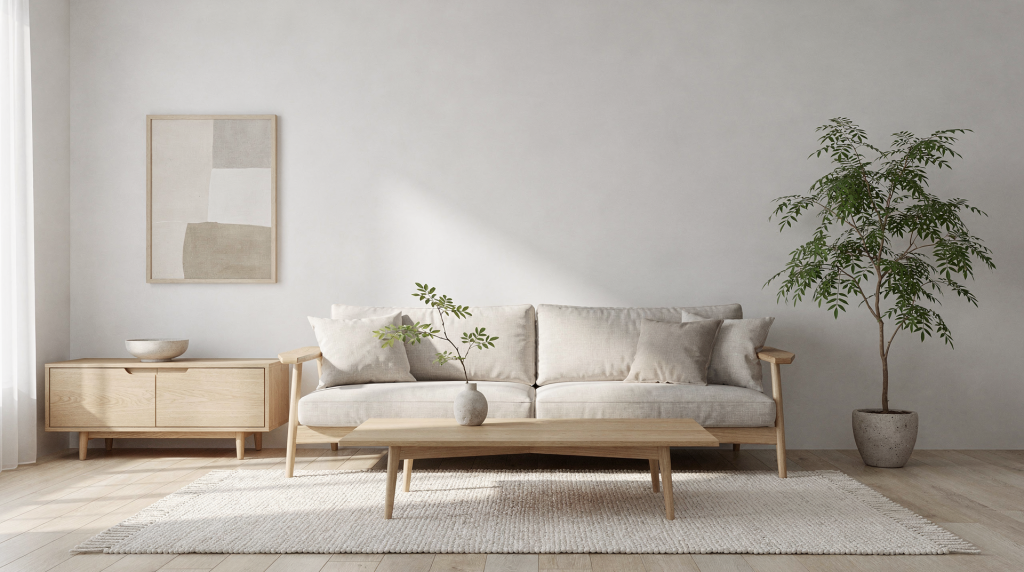
Japandi interior design is one of the easiest ways to make a home feel calmer, warmer, and more intentional at the same time. It blends Japanese minimalism with Scandinavian comfort, which is why the style feels both pared back and livable rather than stark or overly curated. I’ve recommended this approach to countless clients—from first-time renters in studio apartments to families settling into their forever homes—because it adapts to real life without demanding a complete overhaul. The beauty of Japandi is that it works with what you already have, guiding you toward fewer, better things and a quieter, more grounded atmosphere.
What Japandi Really Means
At its core, Japandi is a fusion of two design languages:
- Japanese interiors contribute restraint, simplicity, and respect for natural materials.
- Scandinavian interiors bring softness, comfort, and a practical, everyday approach to living.
The result is a style built around balance. You get clean lines without coldness, minimalism without emptiness, and warmth without clutter. That is the key difference between Japandi and many other “minimal” looks: it is meant to feel human. In a well-executed Japandi room, the Japanese influence keeps the space from tipping into overly cozy chaos, while the Scandinavian side ensures it never feels austere or museum-like. It’s a dialogue between two philosophies, and when it works, you sense it immediately—a living room where a low oak table meets a linen throw, or a bedroom where a paper lamp softens the geometry of a simple bed frame.
The Core Principles of Japandi Design
Japandi is easy to recognize once you know what to look for. It usually follows a few clear rules.
1. Function comes first
Every piece should earn its place. Furniture is chosen for use, storage, comfort, or all three. Decorative objects exist, but they are never there just to fill space. In a rental, this principle is a lifesaver: a bench that doubles as shoe storage or a side table with a drawer does more than a purely sculptural piece ever could. When I source for small spaces, I always ask, “What job does this do?” If the answer is only “look pretty,” it’s usually the first thing to go.
2. Clutter is removed, not disguised
Japandi rooms are visually quiet. Surfaces stay clear, storage is integrated, and open shelving is used carefully. The goal is to reduce visual noise, not hide it behind more styling. This doesn’t mean you have to live like a monk; it means giving every item a home—baskets for throws, closed cabinets for paperwork, a tray to corral the remote and a candle. When you walk into a room and your eye can rest without jumping between dozens of small objects, the space immediately feels larger and more serene.
3. Natural materials lead the scheme
Wood, stone, ceramic, linen, cotton, wool, bamboo, and jute are the usual building blocks. These materials add texture and keep the room from feeling flat. They also age beautifully: a solid wood table gains character with use, linen softens over time, and ceramic develops a patina that no factory finish can replicate. This is where Japandi overlaps with the Japanese concept of wabi-sabi—finding beauty in imperfection and transience.
4. The palette stays soft and low-contrast
Think warm white, beige, sand, greige, soft gray, muted brown, and earthy green. Black may appear, but only as a controlled accent. The low contrast is deliberate; it lets the textures do the talking. In a room with a greige wall, a raw oak shelf, and a charcoal linen cushion, your eye notices the grain of the wood and the weave of the fabric, not a jarring color pop.
5. Craftsmanship matters
Japandi favors well-made pieces with simple forms. A handmade bowl, a solid wood table, or a linen curtain often says more than a room full of accessories. When you run your hand over a hand-thrown ceramic vase or sit on a chair with visible joinery, you feel the intention behind the object. That tactile connection is what keeps the style from feeling mass-produced or impersonal.
Japandi vs Scandinavian: What Is the Difference?
People often confuse the two styles because they overlap, but they are not the same. I’ve walked into rooms that were aiming for Japandi but landed squarely in Scandi territory—still beautiful, but missing that grounded, reflective quality. Here’s how they break down:
| Aspect | Japandi | Scandinavian |
|---|---|---|
| Mood | Calm, grounded, reflective | Bright, cozy, practical |
| Color palette | Warmer, more muted, slightly deeper | Lighter, whiter, airier |
| Materials | Wood, stone, ceramic, linen, bamboo | Wood, wool, linen, leather, painted finishes |
| Styling | More restrained, more intentional | More relaxed, often softer and brighter |
| Visual effect | Minimal but layered | Minimal but fresh |
If Scandinavian design feels like a bright winter morning, Japandi feels like a quiet room in soft afternoon light. In practice, a Scandinavian space might have white walls, a pale wood floor, and pops of pastel or primary color. A Japandi room would lean into greige or warm plaster tones, darker wood, and an almost monochromatic scheme where the variation comes from texture, not hue. Both value simplicity, but Japandi asks for a deeper edit and a more deliberate hand.
How to Build a Japandi Room Step by Step
You do not need to renovate your home to get the look. Start with the basics and build slowly. I’ve used this exact sequence in my own spaces and with clients who were starting from scratch—it works whether you own or rent.
Step 1: Clear the room
Remove anything that does not support the function or mood of the space. Keep only essentials, then add back pieces one by one. This is the hardest step, but it’s the one that makes everything else possible.
Checklist:
- Remove duplicate decor
- Put away small clutter
- Limit visible cables and chargers
- Keep surfaces mostly open
- Store seasonal or rarely used items out of sight
In a rental, this might mean investing in a few good-looking storage baskets or a console with drawers. The goal isn’t to strip the room of personality but to create a blank canvas where every remaining object can breathe.
Step 2: Choose a restrained base palette
Start with one main neutral and two or three supporting tones. A successful Japandi room rarely uses more than a handful of colors. This limitation is freeing: you stop second-guessing whether a new piece will “go” and instead focus on material and form.
Good palette combinations:
- Warm white, oak, charcoal
- Greige, walnut, soft black
- Sand, cream, muted olive
- Stone, beige, dark wood
If you’re renting and can’t paint, use your largest textiles—curtains, a rug, a sofa cover—to establish the base. A set of floor-to-ceiling linen curtains in a warm oatmeal instantly shifts the room’s color temperature without a drop of paint.
Step 3: Add furniture with simple silhouettes
Look for low, solid shapes and avoid overly ornate detailing. Rounded edges often work well because they soften the room. In a compact living room, a low-profile sofa with slim legs keeps sightlines open and makes the ceiling feel higher.
Useful furniture cues:
- Low-profile sofas and beds
- Wood tables with visible grain
- Closed storage with clean fronts
- Simple dining chairs
- Minimal hardware
When shopping, run your hand along the surface. If it feels plasticky or overly slick, it will read as synthetic in the room. Look for matte or oiled finishes that invite touch.
Step 4: Layer texture instead of pattern
Japandi is not about bold prints. It relies on tactile contrast: rough against smooth, matte against polished, woven against solid. This is where the room comes alive. A space with only smooth surfaces feels flat; add a nubby wool throw, a raw ceramic vase, and a jute rug, and suddenly the same neutral palette has depth.
Try combining:
- Linen curtains with a wood floor
- A ceramic lamp beside a wool throw
- A matte plaster wall with a smooth oak table
- A woven rug under a clean-lined sofa
In a bedroom, layer linen bedding with a quilted cotton coverlet and a single wool cushion. The mix of textures makes the bed inviting without needing a pile of pillows.
Step 5: Keep decor small and meaningful
Choose fewer pieces, but let each one feel considered. A vase, a branch, a tray, and a handmade bowl can do more than dozens of objects. When I style a shelf, I often leave empty space around a single ceramic piece—the negative space becomes part of the composition. Art should follow the same rule: one large, quiet piece often anchors a wall better than a gallery of small frames.
Best Materials for a Japandi Interior
The material mix is one of the easiest ways to make the style feel authentic. I always advise people to touch things before they buy—if a material feels good in your hand, it will feel good in the room.
| Material | Why it works | Best use |
|---|---|---|
| Wood | Adds warmth and structure | Furniture, flooring, shelving |
| Linen | Softens the space naturally | Curtains, bedding, cushions |
| Wool | Brings warmth and depth | Throws, rugs, upholstery |
| Ceramic | Feels handmade and grounded | Vases, tableware, lamps |
| Stone | Adds quiet weight | Tabletops, trays, accents |
| Bamboo | Lightens the palette | Screens, accessories, small furniture |
| Jute | Introduces texture | Rugs, baskets, storage |
Avoid materials that feel too shiny, synthetic, or visually busy unless they are used sparingly. A high-gloss lacquer or a metallic finish can break the spell instantly. If you need a touch of sheen, consider a hand-rubbed oil on wood or a matte ceramic glaze that catches light softly.
Japandi Color Palette: What Works and What to Avoid
The safest Japandi palettes stay close to nature. Warmth matters more than brightness. I often tell clients to look at a landscape they love—a pebble beach, a winter forest, a clay desert—and pull colors from that.
Good Japandi colors
- Warm white
- Oatmeal
- Beige
- Sand
- Greige
- Taupe
- Soft gray
- Muted olive
- Clay
- Charcoal
- Black, in small amounts
Colors to use with caution
- Strong primary colors
- Neon shades
- High-contrast black and white
- Glossy finishes
- Very cool grays that feel sterile
A useful rule: if the color looks too energetic for a quiet room, it probably does not belong in Japandi. That said, a single deep indigo cushion or a dark olive throw can work beautifully as an accent, provided the rest of the room stays muted.
Lighting in Japandi Interiors
Lighting is a major part of the style. Harsh overhead light works against the atmosphere, while layered, soft lighting supports it. I’ve seen beautifully furnished rooms fall flat under a single cool-white ceiling fixture. Swap the bulb, add a lamp, and the whole mood transforms.
Aim for three layers
- Ambient light for overall brightness
- Task light for reading, cooking, or working
- Accent light for warmth and depth
Better Japandi lighting choices
- Paper or linen shades
- Warm bulbs (2700K–3000K)
- Low table lamps
- Wall sconces
- Diffused light near seating areas
Natural light should be left as open as possible. Heavy curtains and crowded windows usually weaken the effect. In a rental with unattractive blinds, hang sheer linen panels to filter light without blocking it—they add softness and privacy while keeping the room airy.
Japandi Styling Rules for Each Room
Living room
The living room should feel calm, open, and easy to use. This is where you’ll notice the difference between a room that’s styled for a photo and one that actually works for daily life.
Do this:
- Use a low sofa with clean lines
- Add one coffee table in wood or stone
- Keep decor to a few strong pieces
- Use a rug to anchor the seating area
- Include one or two plants if the room can support them
Avoid:
- Too many cushions
- Large amounts of ornamentation
- Overly glossy finishes
- Furniture pushed into decorative shapes for no reason
I like to place a single branch in a tall ceramic vase on the floor rather than a busy arrangement on the coffee table. It draws the eye up and keeps surfaces clear.
Bedroom
The Japandi bedroom should feel restful first and stylish second. Linen bedding in a muted tone is non-negotiable for me—it breathes well, looks better with a few creases, and gets softer with every wash.
Do this:
- Keep the bed frame low and simple
- Use linen bedding in a muted tone
- Limit bedside decor
- Choose closed storage where possible
- Use soft, warm bedside lighting
Avoid:
- Over-layered bedding in too many colors
- Matching furniture sets that feel generic
- Bright art directly above the bed if it competes with the calm mood
A single piece of textile art or a subtle ink drawing above the bed can be enough. The goal is to wake up to a room that feels like a exhale.
Kitchen
A Japandi kitchen works best when it feels orderly and honest. Even in a rental with dated cabinets, you can shift the mood by clearing counters and introducing natural materials.
Do this:
- Use simple cabinetry
- Keep counters clear
- Choose natural wood or matte finishes
- Display only a few useful items
- Bring in ceramics, glass, and wood rather than plastic-looking accessories
Avoid:
- Open shelving packed with mixed items
- Glossy cabinet fronts that reflect too much
- Too many visible appliances
A wooden cutting board leaning against the backsplash, a ceramic utensil holder, and a linen tea towel can do more for the look than a full renovation.
Bathroom
This is where Japandi can feel especially effective, because small rooms benefit from visual simplicity. I’ve turned the tiniest bathrooms into spa-like retreats just by swapping out plastic bottles for amber glass dispensers and adding a teak stool.
Do this:
- Keep towels neutral
- Use stone, wood, or matte finishes
- Store products out of sight
- Add one or two natural objects only
- Choose mirrors with simple frames
If you’re renting and can’t change tiles, bring in a jute bath mat, a wooden tray for toiletries, and a small ceramic vase with a single stem. The effect is immediate and completely reversible.
Common Japandi Mistakes
Japandi is easy to get almost right and still miss the point. These are the most common issues I see.
- Making the room too empty, so it feels unfinished rather than calm. A room needs texture and a few anchoring pieces to feel inhabited.
- Using beige everywhere without texture, which makes the space flat. If everything is smooth and matte, the room reads as bland, not serene.
- Mixing too many styles, such as industrial lighting, boho accents, and Japandi furniture in one room. The result is visual confusion, not fusion.
- Buying “minimalist” furniture that looks cheap instead of refined. Thin veneers and hollow legs undermine the sense of quality that Japandi relies on.
- Filling the room with decorative objects that have no function. Even a beautiful object should feel like it belongs, not like it’s competing for attention.
- Using cool, sterile lighting that kills the warmth of the space. Always check the Kelvin rating on bulbs—anything above 3000K can feel clinical.
The style works when restraint feels thoughtful, not accidental. If you walk into a Japandi room and it feels cold or unfinished, it’s usually a sign that one of these mistakes is at play.
How to Tell If Your Room Is Really Japandi
Use this quick self-check. I run through these questions mentally every time I finish a project.
Japandi checklist
- Does the room feel calm when you walk in?
- Are most pieces useful, not just decorative?
- Do the materials feel natural and tactile?
- Is the color palette soft and cohesive?
- Are the surfaces mostly clear?
- Do the furnishings feel simple but not bland?
- Is there a sense of warmth, not just minimalism?
If you can answer yes to most of these, you are on the right track. If not, identify which principle is missing and adjust from there—usually it’s a lack of texture or a lighting issue.
Japandi for Small Spaces
Japandi is especially effective in apartments and compact homes because it favors simplicity and storage. I’ve worked with studio apartments where the Japandi approach made the difference between a room that felt cramped and one that felt like a sanctuary.
Best strategies for small spaces:
- Choose multi-use furniture
- Keep large pieces visually light
- Use one consistent palette throughout
- Hide everyday clutter
- Let natural light stay unobstructed
- Use mirrors carefully, only where they improve light
In small rooms, Japandi should make the space feel quieter and more breathable, not sparse. A low bed with storage drawers, a wall-mounted shelf instead of a bulky bookcase, and a folding screen to hide a work zone can all help maintain the calm without sacrificing function.
When Japandi May Not Be the Right Style
Japandi is not ideal for every home or every personality. I’ve had clients who love the idea of it but feel constrained by the muted palette and strict editing. That’s perfectly fine.
It may feel limiting if you:
- Love bold color
- Prefer highly layered maximalist rooms
- Enjoy collecting and displaying many objects
- Want lots of decorative contrast
- Prefer ornate or traditional detailing
That does not mean you cannot borrow from Japandi. You may simply want to use its principles, such as natural materials and clutter control, without committing to the full aesthetic. A maximalist room can still benefit from a linen curtain or a hand-thrown ceramic piece; it just won’t read as Japandi overall.
Practical Shopping Priorities
If you are building a Japandi room from scratch, buy in this order:
- Storage pieces
- Main furniture
- Lighting
- Textiles
- A small number of accessories
- Art, only after the room already feels balanced
This order prevents the most common mistake: styling before the essentials are in place. I’ve seen too many people buy a beautiful vase and then realize they have nowhere to put it because the room lacks a proper sideboard. Start with function, then layer in beauty.
Final Takeaway
Japandi interior design is not just a look. It is a way of arranging a home so that every object feels calm, useful, and considered. The style works because it balances simplicity with warmth, which makes it easier to live with than many trend-driven interiors. In my own home, the pieces I’ve kept longest are the ones that follow these rules: a solid oak bench, a linen throw that’s been washed a hundred times, a ceramic lamp with a paper shade. They don’t shout, but they make the room feel right.
If you start with natural materials, a muted palette, clean-lined furniture, and honest restraint, you will be much closer to the right result than if you chase a perfect “Japandi aesthetic.” The best Japandi rooms do not look decorated. They look lived in, but edited with care.
FAQ
What is Japandi interior design?
Japandi is a design style that blends Japanese minimalism with Scandinavian warmth, using natural materials, muted colors, and simple, functional furniture. It creates spaces that feel serene and grounded, never cold or impersonal.
Is Japandi the same as minimalism?
No. Japandi is minimal, but it is warmer and more tactile than strict minimalism. It focuses on comfort as well as simplicity. Where pure minimalism can sometimes feel stark, Japandi invites you to touch the linen, feel the wood grain, and settle in.
What colors are best for Japandi interiors?
Warm whites, beige, sand, greige, soft gray, muted olive, clay, charcoal, and small amounts of black work well. The key is to keep contrast low and let texture provide the visual interest.
Can Japandi work in a small apartment?
Yes. Japandi is especially effective in small spaces because it reduces visual clutter and makes rooms feel calmer and more open. With smart storage and a restrained palette, even a studio can feel expansive.
What should I avoid in a Japandi room?
Avoid clutter, glossy finishes, overly bright colors, too many decorative objects, and furniture that feels ornate or visually heavy. Also steer clear of cool-toned lighting, which can wash out the warmth that defines the style.