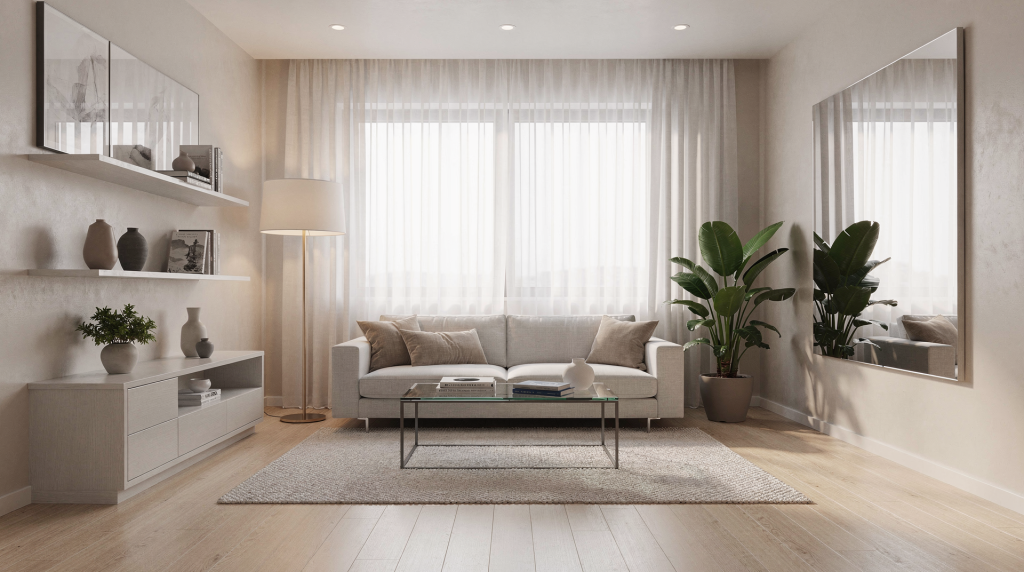
I’ve walked into plenty of London flats where the living room was barely 12 square metres, yet it felt calm and open — not because it was sparsely decorated, but because every choice had a purpose. A small living room can feel airy, balanced, and much more generous than its square footage suggests. The trick is not to “decorate it smaller,” but to make every choice work harder: better light, clearer sightlines, smarter furniture, and fewer visual interruptions. When I used to source textiles and decor for Shiloh Home’s shop, I learned quickly that the pieces people kept longest were the ones that didn’t fight the room — they let it breathe.
Why small living rooms feel cramped
Most tight living rooms suffer from the same problems: too much furniture, poor lighting, bulky window treatments, and clutter that breaks up the floor plan. I’ve seen it time and again — a sofa that’s too deep for the room, a coffee table that blocks the walkway, and curtains that swallow whatever natural light manages to filter through. The room may be fine structurally, but visually it feels crowded because the eye has nowhere to rest. In many English homes, the issue isn’t the footprint itself; it’s that the pieces inside are scaled for a larger space, or the layout forces you to weave around obstacles. The good news is that you do not need a renovation to fix that. In most homes and apartments, the biggest gains come from layout, scale, and light rather than adding more décor. A well-edited room with a clear path and layered lighting will always feel larger than one stuffed with furniture, no matter the square metre count.
Start with the layout, not the shopping list
Before you buy anything, map the room. I always tell people to measure the walls, the main walkways, and the distance between the sofa, coffee table, and TV or focal point — and then live with the empty space for a day if you can. A room feels larger when you can move through it easily and when furniture does not block circulation. In rental flats where you can’t change the structure, this step is even more critical because layout is your main tool. Even shifting a sofa a few inches away from the wall can change how the whole room breathes.
What to do first
- Keep at least one clear path through the room — ideally the one you use most often.
- Pull furniture slightly away from walls if the room allows it; a few centimetres of breathing space behind a sofa softens the perimeter.
- Choose one focal point and build around it, whether it’s a fireplace, a window, or a piece of art.
- Remove any piece that duplicates the same function unnecessarily — two side tables serving the same corner, for instance.
A common mistake is pushing everything against the walls and assuming that will create more space. In reality, it often makes the room feel more like a waiting area than a proper living space. I’ve seen this in countless first homes: sofas lined up like soldiers, leaving an awkward empty dance floor in the middle that no one uses. A better layout anchors the seating and lets the room feel intentional.
Use fewer, better pieces
Small rooms usually look bigger when they contain fewer items of stronger visual quality. That does not mean bare or cold — it means editing with intention. When I was sourcing for the shop, I’d often advise customers to invest in one good armchair rather than two mediocre ones. The visual weight of a piece matters as much as its physical size. Look for furniture that doesn’t sit heavily on the floor: a sofa with a slimmer profile, an armchair with visible legs, a coffee table that feels light rather than blocky. Storage pieces that do double duty — like an ottoman that holds blankets and doubles as seating — earn their keep in a compact room. Nesting tables are another favourite of mine because they offer flexibility without permanently crowding the floor.
Furniture with exposed legs helps because you can see more floor beneath it. That creates a sense of openness, even when the room itself is compact. In a small space, the floor is precious visual real estate, and anything that lets your eye travel across it uninterrupted will make the room feel larger.
Best furniture choices for a small living room
| Better choice | Why it helps |
|---|---|
| Slim sofa or loveseat | Takes up less visual weight and leaves more breathing room around it |
| Ottoman with storage | Hides clutter and can serve as seating or a footrest without adding bulk |
| Nesting side tables | Flexible without crowding the floor; tuck one away when not needed |
| Wall-mounted shelf or media unit | Frees up floor area and keeps the sightline open underneath |
| Armchairs with open bases | Makes the room feel lighter because you can see through and under them |
Let light do the heavy lifting
Light is one of the most effective tools for making a small living room feel larger, and it’s often the one people overlook in favour of furniture swaps. Natural light makes a room feel open, and layered artificial lighting keeps the space from collapsing into dark corners at night. I’ve walked into rooms where a single ceiling fixture cast harsh shadows, making the walls feel closer than they were. The fix was rarely more wattage — it was better distribution.
Improve daylight
- Use sheer curtains or light-filtering blinds that soften the light without blocking it.
- Hang curtains higher and wider than the window — this is one of the oldest tricks in the book, and it works every time.
- Keep window areas visually clean; avoid heavy valances or fussy pelmets that eat into the glass area.
- Avoid heavy fabric that blocks too much light; even a lined linen can be too dense if the room is north-facing.
If possible, let the curtain rail sit above the window frame and extend beyond the sides. That simple move makes the window read as taller and wider, and it costs nothing but a bit of extra track. In rented flats where you can’t drill, tension rods placed high achieve a similar effect.
Layer your lighting
A single ceiling light often flattens a small room, washing out any sense of depth. Instead, use several light sources at different heights. I like to think of lighting in layers: a general wash, task light, and accent. In a compact living room, that might mean a central pendant for overall brightness, a table lamp on a side table for warmth, a wall light or picture light to draw the eye upward, and a floor lamp tucked into a dark corner to push back the shadows. Layered lighting creates dimension, and dimension makes a room feel more spacious. It also changes how textiles read — a linen throw under a warm lamp looks entirely different than under a cool overhead light, and that softness adds to the sense of comfort without clutter.
Mirrors: useful, but only when placed well
Mirrors are not magic, but they are excellent at bouncing light and extending views. Their placement matters more than their size. I’ve seen enormous mirrors leaned against a wall that did nothing but reflect a dark corner back at itself — that’s a missed opportunity. A well-placed mirror can double the light in a room and make a narrow wall feel wider.
Where mirrors work best
- Opposite a window to reflect daylight straight back into the room.
- Near a window to amplify brightness and catch the light from an angle.
- Above a mantel or console to add height and draw the eye upward.
- On a narrow wall to broaden the perceived space — a horizontal orientation works well here.
A large mirror can be more effective than several small ones because it gives the eye a cleaner reflection and reduces visual clutter. In a small room, one generous mirror with a simple frame often does more than a gallery of smaller ones, which can start to feel like a collection of shiny distractions.
Choose a calm colour strategy
Light, cohesive colours usually make a small living room feel larger, but the goal is not to paint everything stark white unless that suits the rest of the home. In English interiors, soft neutrals, warm whites, pale greys, muted greens, and gentle stone tones all work beautifully. The key is continuity — when walls, skirting boards, and ceiling are similar in tone, the room feels less chopped up. That creates visual continuity, which is exactly what a small space needs. I’ve seen rooms where a white ceiling against darker walls created a hard line that visually lowered the height; painting the ceiling a softer version of the wall colour can lift it.
Colour rules that help
- Keep walls and trim close in tone — you don’t need an exact match, but avoid sharp contrast.
- Use one main colour family and let variations in texture do the work.
- Limit high-contrast breaks; a single dark accent wall can sometimes work, but it often shrinks the room visually.
- Repeat the same accent colour in small doses — a cushion, a vase, a piece of art — to create rhythm without fragmentation.
Make the floor feel as open as possible
The floor area is precious in a small living room. Anything that interrupts it too much — a jumble of small rugs, too many freestanding objects, chunky furniture that sits directly on the ground — can make the room feel cramped. I always look at the floor first when assessing a room, because it’s the foundation of how you move through the space.
Practical ways to keep the floor clear
- Choose a rug that fits the seating area properly; at minimum, the front legs of the sofa and chairs should sit on it.
- Avoid too many freestanding objects like floor cushions, extra stools, or plant stands that break up the walking path.
- Use wall storage where possible — floating shelves, wall-mounted cabinets, or a media unit fixed to the wall.
- Pick furniture with raised legs so you can see the floor extending underneath.
- Keep cables and baskets under control; a tangle of wires or a cluster of small bins reads as visual noise.
A rug that is too small can make the room feel even more constrained, as if the seating area is floating in the middle of nowhere. A better-sized rug anchors the seating area and helps the room feel intentional instead of pieced together. In a compact living room, I’d rather see a single larger rug than two small ones competing for attention.
Use vertical space
When floor space is limited, the eye should be drawn upward. This is one of the simplest ways to make a small living room feel taller and more elegant, and it’s especially useful in smaller English flats where ceiling height may be modest but not impossible to visually enhance. I’ve worked with rooms where simply hanging curtains from ceiling to floor added a foot of perceived height.
Ways to use height well
- Hang art slightly higher than you might instinctively place it, but not so high that it feels disconnected from the furniture below.
- Use tall bookcases or floor-to-ceiling storage — even a narrow shelving unit draws the eye up.
- Choose curtains that run from ceiling to floor; this vertical line is one of the most effective tricks in a small room.
- Add a tall lamp or vertical artwork to create a strong upward line.
- Keep shelf styling sparse and orderly; overcrowded shelves pull the eye down and feel heavy.
Vertical lines create the impression of height. In a room with standard ceiling height, a tall, slim bookcase or a pair of floor-to-ceiling curtains can transform the proportions without any structural change.
Keep patterns and textures controlled
Texture adds warmth, but too many competing patterns can make a small room feel busy. The aim is layered, not noisy. This is where my background in textiles comes in most: a linen throw, a wool cushion, or a textured rug can add depth without crowding the space. The key is restraint — let one or two textures lead, and keep the rest quieter. In a small room, a heavily patterned wallpaper on all four walls can feel like the room is closing in, while a single textured wall or a patterned cushion on a neutral sofa adds just enough interest.
A good formula
- One main upholstery texture — perhaps a soft linen or a brushed cotton on the sofa.
- One or two supporting textures — a nubby wool cushion, a velvet pouf, a chunky knit throw.
- A subtle patterned cushion or throw that picks up a colour from elsewhere in the room.
- One rug that grounds the room and adds texture underfoot.
- One or two decorative objects per surface — a ceramic bowl, a small vase, a candle — to avoid clutter.
This formula works because it gives the eye enough to explore without overwhelming it. In a compact living room, every textile choice should earn its place by adding either comfort or visual depth — ideally both.
Create one strong focal point
A small living room looks bigger when it has a clear visual anchor. Without one, the room can feel like a collection of unrelated objects, and the eye darts around without settling. I’ve seen rooms where a single large artwork transformed the space, giving it a sense of purpose that no amount of small accessories could achieve.
Good focal points include
- A fireplace — even a non-working one with a simple mantel.
- A large piece of art that commands attention without shouting.
- A statement mirror that reflects light and adds depth.
- A well-styled media wall where the television is integrated thoughtfully, not dominating.
- A window with simple, elegant dressing that frames the view.
If the room has no natural focal point, create one deliberately. For example, one large artwork often works better than several tiny frames because it gives the eye a place to land. In a rental where you can’t hang heavy pieces, a large canvas leaned on a console or mantel can serve the same purpose.
Styling mistakes that make a small living room feel smaller
| Mistake | Why it causes problems | Better approach |
|---|---|---|
| Oversized sofa | Dominates the floor plan and leaves little room for movement | Choose a slimmer silhouette with a shallower seat depth |
| Too many small items | Creates visual noise and makes surfaces feel chaotic | Edit decor and group objects in odd numbers on trays or books |
| Dark, heavy curtains | Blocks light and adds visual weight to the perimeter | Use lighter window treatments in natural fibres like linen |
| Tiny rug | Breaks up the room and makes the seating area feel disconnected | Size the rug to the seating area so furniture sits on it |
| Cluttered shelves | Makes the room feel busy and pulls the eye down | Leave breathing room; style with books, a few objects, and empty space |
| Furniture flush against every wall | Can look awkward and rigid, like a waiting room | Allow some space where possible to create a softer perimeter |
A step-by-step plan to make the room feel larger
1. Clear the room
Remove anything nonessential. Start with side tables, extra stools, decorative clutter, and duplicate seating. Seeing the empty room helps you understand its true proportions before you put things back.
2. Measure the key pieces
Check the sofa, rug, and coffee table before changing anything. In small rooms, scale matters more than style alone. A sofa that’s too deep can eat up a metre of floor space you didn’t realise you were losing.
3. Set the main path
Make sure people can enter, sit down, and move around without squeezing past furniture. Walk the route yourself and adjust until it feels natural.
4. Improve the light
Open up the windows, swap heavy curtains for lighter treatments, and add at least two lighting sources beyond the ceiling fixture. Even a simple table lamp can change the mood entirely.
5. Anchor the seating area
Use a properly sized rug, one main coffee table, and a clear focal point. This grounds the room and gives it a centre of gravity.
6. Edit the styling
Keep surfaces simple. Use a few meaningful pieces instead of many small accessories. A single beautiful bowl or a stack of books can feel more intentional than a scatter of tiny objects.
7. Add height
Use tall curtains, vertical art, or a bookcase that draws the eye upward. This final step often makes the biggest difference in how tall the room feels.
Quick checklist
- ☐ The room has a clear walking route
- ☐ Furniture scale suits the room size
- ☐ Natural light is not blocked unnecessarily
- ☐ Curtains are light and hung high
- ☐ At least two lighting layers are in place
- ☐ The rug fits the seating arrangement
- ☐ Surfaces are not overcrowded
- ☐ The colour palette feels cohesive
- ☐ There is one clear focal point
- ☐ Storage is hidden where possible
What matters most if you can only change three things
If the budget is limited — and in a first home or rental, it often is — focus on these three changes first:
- Improve lighting: add a floor lamp or swap heavy curtains for sheers. Light is the cheapest way to expand a room visually.
- Replace oversized or bulky furniture: a slimmer sofa or a lighter coffee table can free up more floor than you’d expect.
- Correct the rug and curtain scale: a properly sized rug and curtains hung high and wide will change the proportions of the room overnight.
Those three adjustments usually create the biggest visual difference for the least effort, and they don’t require a full redesign.
Final thoughts
A small living room feels larger when it is edited with care. Light, scale, and circulation matter more than trends, and the best rooms usually look calm rather than crowded. Over the years, I’ve learned that the pieces that truly work in a compact space are the ones that let the room breathe — a linen throw that adds softness without bulk, a mirror that doubles the light, a sofa that doesn’t demand the entire floor. If every object earns its place, the room will feel more generous, more polished, and much easier to live in. That’s the kind of space that welcomes you in, no matter its size.
FAQ
What colour makes a small living room look bigger?
Soft light neutrals, warm whites, pale greys, and muted tones usually help a small living room feel more open because they reflect light and reduce visual breaks. That said, a darker colour used cohesively on walls and woodwork can sometimes blur the boundaries and make a room feel larger in a cocooning way — but it requires confident styling and good natural light.
Does a bigger rug make a room look larger?
Usually, yes. A rug that properly fits under the front legs of the main furniture can unify the space and make it feel more cohesive. A rug that’s too small tends to fragment the floor and make the room feel pieced together rather than intentional.
Are mirrors worth using in a small living room?
Yes, if they are placed well. A mirror across from a window or near one can reflect daylight and make the room feel brighter and more open. Just avoid placing a mirror where it reflects a cluttered corner — it will double the visual chaos.
Should furniture go against the walls in a small living room?
Not always. In many cases, pulling pieces slightly away from the walls improves flow and prevents the room from feeling boxed in. Even a few centimetres of space behind a sofa can soften the perimeter and make the room feel less rigid.
What is the biggest mistake people make in small living rooms?
Using furniture and accessories that are too large, too many, or too dark for the space. Visual clutter is usually the fastest way to make a small room feel smaller. Editing down to fewer, better pieces almost always yields a more spacious feel.