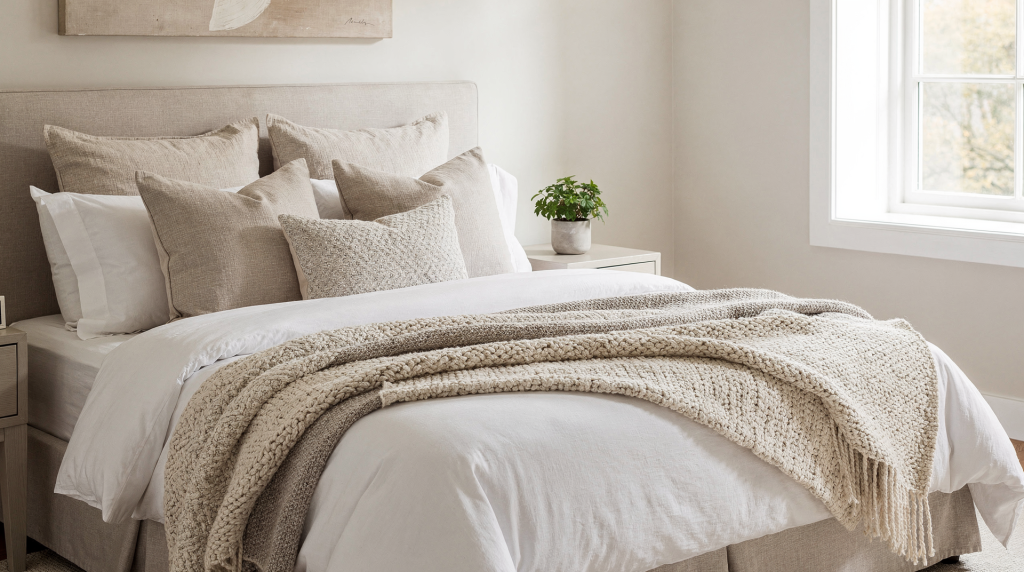
A well-layered bed does more than look polished: it makes a bedroom feel finished, intentional, and more inviting. The good news is that you do not need a large budget or a designer’s eye to get there — you just need a clear formula, the right mix of textures, and a few styling decisions made in the right order.
Why layered bedding works
A layered bed feels richer because it combines contrast: soft against structured, smooth against textured, plain against patterned. When everything matches too closely, the bed can look flat — almost like a hotel room that forgot its personality. When layers are added with intention, the result feels relaxed but considered, as if the bed has been slowly assembled over time rather than bought in a single shopping trip.
In practice, layering also helps a bedroom work harder. Throws add warmth and flexibility; they are the piece you reach for on a cool evening or the layer that protects the duvet from a cat who has claimed the foot of the bed. Cushions create height and visual depth, giving the eye a place to land. Together, they can make a simple duvet look more substantial without adding clutter — which is especially useful in a rental where you cannot change the bed frame or wall colour, but you can control the textiles.
Start with the bed you already have
Before adding anything decorative, make sure the foundation looks neat. No amount of cushions will fix a duvet that is too small, sheets that wrinkle easily, or pillows that collapse during the day. I have walked into too many rooms where the throw is beautifully draped but the fitted sheet is pulling at the corners — and that is all anyone notices.
Your base should be:
- A fitted sheet that fits properly — deep pockets matter more than thread count here
- A duvet or comforter with enough volume for the bed size; an undersized duvet leaves gaps at the edges that no throw can hide
- Pillows that hold their shape — if they fold in half when you prop them up, it is time to replace the inserts
- A neutral or coordinated base layer if you want flexibility with styling; white, cream, or soft grey gives you the most freedom to swap throws and cushions seasonally
If the base is visually messy, the extra layers will only highlight it. A layered bed looks best when the background is calm — think of the sheets and duvet as the canvas, not the painting.
The simplest formula for a layered bed
If you want a quick, reliable setup that works in almost any bedroom, use this structure:
- Make the bed with smooth sheets and a duvet.
- Add sleeping pillows upright or slightly propped.
- Place one or two decorative cushions in front.
- Finish with a throw at the foot of the bed or draped to one side.
That formula works because it creates a clear visual hierarchy: functional bedding in the back, decorative layers in front. The eye reads it the way it reads a well-composed photograph — background first, then the details. In a small bedroom, this order also keeps the bed from dominating the room; the layers feel intentional rather than piled on.
Choosing throws: what matters most
A throw should do two jobs: add texture and break up the large flat surface of the duvet. It does not need to match everything exactly, but it should feel related to the rest of the room — a throw that looks like it wandered in from another colour palette will always feel slightly off, no matter how beautiful it is on its own.
When I am sourcing throws for a shoot or helping someone style their first apartment, I always look at the fabric first. The material determines how the throw drapes, how it catches light, and how it feels when you actually use it.
Best throw fabrics for a layered bed
| Fabric | Look and feel | Best for |
|---|---|---|
| Linen | Relaxed, airy, slightly rumpled | Casual, editorial bedrooms |
| Cotton | Clean and easy to live with | Everyday use |
| Chunky knit | Soft and tactile | Cozy, winter styling |
| Waffle weave | Textured but light | Minimal bedrooms |
| Faux fur | Plush and dramatic | Colder months, luxe feel |
A good rule is to choose a throw that contrasts with the duvet. If the duvet is smooth, try something with texture — a chunky knit over crisp cotton creates instant depth. If the bedding is already textured, keep the throw simpler so the bed does not feel busy. I have seen a heavily patterned duvet paired with a heavily textured throw, and the result was a bed that felt visually loud, not layered.
How to place a throw on a bed
There are a few reliable ways to style a throw. Each creates a different mood, and the method you choose should match how you actually live with the bed. A throw that looks perfect in a photograph but slides off the moment you sit down is not doing its job.
1. Folded across the foot of the bed
This is the cleanest, most structured option. Fold the throw into thirds or halves and lay it horizontally across the lower third of the bed. The edges should be neat, and the throw should sit evenly.
Use this if you want:
- A hotel-like finish
- A tidy look
- A bedroom that feels calm and tailored
This works especially well with heavier or stiffer throws — a thick wool throw holds a fold beautifully, while a slouchy linen throw might look a little too rigid if you try to make it behave this way.
2. Loosely draped for a softer look
Let the throw fall naturally over one corner or across the foot of the bed at a slight angle. This feels more relaxed and lived-in, as if you just got up and left it there — in the best way.
Use this if you want:
- A casual bedroom
- A softer, editorial style
- A bed that feels inviting rather than formal
This is often the best choice for linen or waffle throws, which have a natural drape that looks better when it is not forced into sharp folds. In a rental bedroom with plain white walls, a loosely draped throw in a warm tone can soften the whole room.
3. Half-folded, half-casual
Fold the throw neatly, then let one edge break slightly. This gives the bed some order without making it look over-styled — it is the styling equivalent of rolling up your sleeves.
Use this if you want:
- A balanced look between polished and relaxed
- A style that works in a guest room or main bedroom
- A simple way to avoid perfection
I often use this approach in guest rooms because it signals that the bed is prepared but not precious. Guests should feel they can actually use the throw, not just admire it.
How many cushions do you actually need?
More cushions do not automatically make a bed look better. The goal is to create depth, not overwhelm the sleeping area. I have walked into bedrooms where the cushion arrangement took longer to remove than the actual bedtime routine — that is a sign there are too many.
For most beds, a strong arrangement is:
- 2 sleeping pillows
- 2 large decorative cushions
- 1 smaller accent cushion or lumbar pillow
On a larger bed, you can add more, but the arrangement should still feel controlled. Odd numbers often feel more natural, especially when using smaller accent cushions — a group of three or five reads as more organic than a rigid pair.
Cushion sizing guide
| Bed size | Good cushion formula | Notes |
|---|---|---|
| Single | 1–2 decorative cushions | Keep it simple to avoid crowding |
| Double | 2 sleeping pillows + 2 cushions | A lumbar cushion can work well here |
| King | 2–4 decorative cushions | Scale matters more than quantity |
| Super king | 4–5 decorative pieces max | Balance the width of the bed |
The most common mistake is using cushions that are too small. Tiny cushions disappear against a large duvet and headboard — they look like afterthoughts. A better approach is to choose fewer, larger pieces that can actually hold visual weight. A 60cm square cushion on a king bed reads as intentional; a 40cm one reads as lost.
How to layer cushions without making the bed look cluttered
Cushions should add structure, not chaos. Think of them in layers, with the largest pieces at the back and the smallest in front — the same principle as arranging furniture in a room, where taller pieces anchor the back and lower ones create foreground interest.
A simple arrangement that works
- Place the sleeping pillows upright.
- Add two larger square cushions in front.
- Finish with one smaller cushion or a lumbar cushion.
This creates depth and makes the bed feel styled without looking overdone. The sleeping pillows act as a backdrop, the square cushions add volume, and the lumbar cushion gives the eye a focal point.
For a more relaxed look
- Keep the sleeping pillows slightly visible — do not bury them completely behind decorative layers
- Lean cushions rather than stacking them too tightly; a slight angle feels more casual
- Use one statement cushion instead of several small ones — a single textured or patterned piece can carry the whole arrangement
For a more polished look
- Keep cushions symmetrical — matching pairs on each side create order
- Use matching pairs
- Align the edges neatly
- Choose shapes that echo the bed’s proportions — rectangular cushions on a long bed, square on a more compact one
Mixing textures the right way
Texture is what makes a layered bed look expensive, even when the palette is simple. The key is contrast. A bed dressed entirely in smooth cotton can feel flat, but add one nubby linen throw and suddenly the whole arrangement has dimension.
Good texture combinations
- Crisp cotton sheets + linen throw + velvet cushions
- Smooth duvet + chunky knit throw + woven cushions
- Washed linen bedding + wool throw + simple cotton cushions
- Quilted coverlet + soft lumbar cushion + textured throw
Avoid using too many highly textured pieces at once. If everything is fluffy, nubby, or patterned, the bed loses clarity — it becomes a jumble of surfaces rather than a composition. I usually limit myself to two or three distinct textures and let the rest recede.
Choosing colors that feel cohesive
You do not need a perfectly matched set. In fact, that usually looks too flat — the kind of bed that came out of a bag with matching shams and a coordinating throw. A better approach is to build a limited palette that feels collected, not coordinated.
Easy color formula
- 1 base color from the bedding
- 1 supporting neutral
- 1 accent color repeated in the cushions or throw
For example:
- White bedding + oatmeal throw + rust cushion
- Soft grey bedding + charcoal throw + pale blue cushion
- Cream bedding + olive cushion + natural textured throw
The safest route is tonal styling: use different shades of the same color family. That creates depth without visual noise — a bed layered in creams, oatmeals, and warm taupes feels richer than one in a single flat beige, but it never looks busy.
Seasonal styling: when to change the layers
A layered bed should change with the season. The structure can stay the same, but the materials should shift. I keep the same cushion arrangement year-round and simply swap the textiles — it is the easiest way to make the bedroom feel current without redecorating.
Spring and summer
- Use lighter throws — linen and lightweight cotton are ideal
- Choose breathable fabrics like cotton and linen
- Keep cushion fills and textures less bulky; a flatwoven cushion cover feels cooler than a chunky knit
- Lean into pale or muted tones — soft blues, greens, and sandy neutrals
Autumn and winter
- Add heavier throws — wool, cashmere blends, or chunky knits
- Use deeper colors — ochre, burgundy, forest green, charcoal
- Bring in tactile fabrics like wool, boucle, or faux fur
- Increase the visual weight at the foot of the bed; a thick folded throw anchors the space
You do not need to overhaul the whole bed each season. Swapping the throw and one or two cushions usually changes the mood enough. In a small apartment where storage is limited, I keep a summer set and a winter set in under-bed boxes and rotate them when the weather turns.
A practical styling checklist
Before you call the bed finished, check the following:
- The duvet is smooth and evenly fluffed — no lumps or uneven distribution
- Sleeping pillows are upright and balanced
- Cushions are sized proportionally to the bed
- The throw adds contrast instead of blending in
- The color palette feels intentional
- The arrangement looks good from the doorway, not just up close — step back and see how the bed reads as part of the whole room
If the bed feels off, step back and simplify. Often the fix is removing one cushion or changing how the throw is draped. I have styled beds where the whole composition clicked into place the moment I took away a single piece.
Common mistakes to avoid
Using too many small cushions
Small cushions can make the bed feel busy and under-scaled. Larger pieces usually work better — they hold their own against the headboard and duvet.
Matching everything too closely
A bed where every textile is the same color and texture often looks flat. Some contrast is essential; even a tonal palette needs variation in texture to feel alive.
Ignoring proportion
A king bed needs larger cushions and throws than a double. Proportion matters more than quantity — one oversized lumbar cushion on a wide bed can look more striking than four small squares.
Styling for photos only
A bed should look good in daily life. If the throw falls apart the moment you sit down, it is not a practical setup. Choose arrangements that survive real use: a loosely draped throw that can be pulled up easily, cushions that can be moved with one hand.
Overloading on pattern
Pattern can work, but keep it controlled. If the throw is patterned, let the cushions stay quieter, or vice versa. I usually limit pattern to one piece per bed — a printed lumbar cushion against solid bedding, or a striped throw over plain sheets.
Step-by-step: how to create the look in 10 minutes
- Smooth the fitted sheet and duvet — take an extra thirty seconds to pull the corners tight and even out the fill.
- Fluff the sleeping pillows and place them upright.
- Add two larger cushions in front.
- Place a smaller cushion or lumbar pillow as the final layer.
- Fold the throw neatly or drape it casually, depending on the mood you want.
- Step back and check whether the bed feels balanced from across the room.
- Remove one item if the arrangement feels crowded.
Best styling formulas by room type
| Room type | Recommended look | Why it works |
|---|---|---|
| Main bedroom | Layered, textured, tonal | Feels calm and lived-in |
| Guest room | Clean, symmetrical, welcoming | Easy for guests to read visually |
| Small bedroom | Fewer layers, stronger scale | Avoids crowding the space |
| Rental bedroom | Neutral base with one accent color | Easy to change without redecorating |
| Cozy retreat | Chunky throw, soft cushions, rich texture | Adds warmth and softness |
FAQ
How many throws should be on a bed?
Usually one is enough. More than one can feel heavy unless the bed is very large or you are intentionally creating a layered seasonal look — for example, a lightweight cotton throw for summer layered over a wool one in early autumn.
Should the throw match the cushions?
It should coordinate, not match exactly. A shared color family is enough. A rust cushion and a terracotta throw work together beautifully without being identical.
Where should the throw go?
The most common placement is across the foot of the bed. You can also drape it to one side for a more relaxed look — this works especially well in bedrooms where the bed is visible from the side as you enter.
Are decorative cushions necessary?
No, but they help finish the bed. If you prefer a simpler look, one lumbar cushion can be enough — it adds a layer without the fuss of multiple pieces.
What is the easiest way to make a bed look designer?
Focus on scale, texture, and restraint. A few good-quality layers always look better than a crowded arrangement. Invest in one beautiful throw and one or two well-proportioned cushions rather than spreading your budget across many smaller pieces.
Final thought
A layered bed should feel complete, not fussy. Start with a clean base, add one throw with real texture, and build cushions in sizes that suit the bed. When the colors are cohesive and the proportions are right, the whole room feels more pulled together — without looking over-styled. The best beds are the ones that invite you in, not the ones that make you afraid to sit down.